



Accumulated work, normalised to body mass as kilojoules per kilogram (kJ/kg), helps coaches understand when a rider’s performance begins to deteriorate.
A rider can have an impressive FTP, strong five-minute power, and perfectly respectable numbers when fresh. But the more interesting question for many events is what is left of those numbers after two, three, or four hours of racing—on the final climb, when closing a gap, when sprinting around the corner, or when attempting to stay with the front group after significant work.
That’s why durability has become such a useful concept in cycling. The principle is fairly simple: What can the rider produce fresh, and what can they still produce after a race-relevant amount of work?
That can tell us something valuable about durability, but it doesn’t necessarily tell us why performance changed.
Why we need to look beyond the kJs
If the rider loses 10% of their five-minute power after a particular workload, that’s useful information. We identified what happened.
The temptation is to move immediately to the prescription: more long rides, more work under fatigue, better fuelling, more threshold work.
But we’re missing one step: Why did the power fall?
What research shows about kJ/kg
Even within durability research, accumulated work is not the complete answer. A 2026 systematic review concluded that kJ alone is limited as a marker of fatigue because the intensity at which the work is accumulated matters.
Higher-intensity prior work can produce greater performance deterioration with less total work than lower-intensity riding, so 30 kJ/kg is not automatically the same physiological challenge every time.
Once we leave the laboratory and put the rider into a race, things become more complicated again.
When a fuelling problem isn’t really a fuelling problem
I coached a rider who was not eating enough during road races. From the outside, the solution seemed obvious: eat.
We could calculate carbohydrate targets, discuss when to start fuelling, and make sure the rider carried enough food. If they subsequently faded, inadequate fuelling would be an obvious explanation.
Except that was not the actual problem.
Through conversation, the rider explained that they were frightened to take a hand off the handlebars while riding in the bunch. Reaching behind into a jersey pocket felt unsafe.
They knew they should eat, and they had the food. They were not lacking nutritional knowledge; something was preventing them from carrying out the strategy.
We tried putting an energy gel at the front of the leg of their shorts. It put the gel within sight, which acted as a reminder, and it made the food feel much easier to reach.
It helped.
But the important intervention had happened before we moved the gel: The rider told me what the real problem was.
What initially looked like a nutritional or physiological issue also contained psychological and technical elements. Fear and confidence in the bunch were influencing whether the rider could execute the fuelling strategy.
Simply telling them to eat more would have been correct advice but poor coaching.
The same performance decline can have different causes
Imagine a group of riders who lose a similar percentage of their five-minute power after the same accumulated kJ/kg. The numbers look remarkably similar.
But one rider may genuinely lack the physiological durability required by the event.
Another may have under-fuelled.
Another may have repeatedly surged through the first half of the race because they were poorly positioned.
Another may have been afraid of losing wheels through fast corners and repeatedly had to accelerate back into the group.
Another may have reached the decisive moment believing everyone around them looks comfortable while they are suffering, making their confidence disappear before their physiological capacity did.
The measured decline still matters, but these riders do not require the same intervention.
For this reason, I find it useful to look beyond the power file through five overlapping areas:
- Biological: fatigue, fuelling, hydration, sleep, illness, recovery
- Psychological: confidence, fear, motivation, perceived exertion, or the belief that everybody else is suffering less
- Social: work, family, travel, relationships, and the environment surrounding the athlete—factors that don’t disappear when the rider presses start on their bike computer
- Technical: bike handling, cornering, position, equipment, and the ability to perform tasks such as eating and drinking safely while riding
- Tactical: positioning, pacing, responding to attacks, and deciding when an effort is worth making
These are not five neat boxes, and they shouldn’t become a five-part questionnaire after every race. They overlap constantly.
A technical weakness can increase psychological stress. A tactical mistake can increase physiological load. Fear in the bunch can stop a rider eating, and a biological problem can change tactical decision-making later in the race.
Performance happens to a person in an environment, not to a power meter.
The role of subjective data in coaching
There is a risk when coaches have access to increasing amounts of training data. We can become very good at talking. We see the file, form an explanation, and tell the athlete what happened. Sometimes we are right.
But the coach has access to another source of information: the athlete.
Power, heart rate, accumulated kJ/kg, pacing, intensity distribution, and fuelling records can all provide objective information about the performance. The athlete can provide something different.
What were they trying to do? What did they feel? What frightened them? Why did they make that decision? When did their confidence change? Why did they not eat? What was happening around them when the numbers started to deteriorate?
This subjective information has its limitations. The athlete may not identify the cause perfectly. Their interpretation is still subjective, and it should not automatically override the objective evidence. But it is another important source of information.
Good coaching is not choosing between objective and subjective data. It is understanding what each can tell us, recognising the limitations of both, and putting them together.
The power file might show where the performance deteriorated. Accumulated kJ/kg can provide context around how much work had been completed. Heart rate, pacing, and intensity distribution can provide further clues.
Then the athlete can describe what was happening inside and around those numbers. That gives the coach a much better chance of solving the right problem.
Data should start the conversation, not finish it
Research into endurance coaching has identified a strong bias towards readily quantifiable physiological information and has highlighted the importance of context and communication, particularly within remote coaching relationships.
That does not mean ignoring objective data. It means using it to ask better questions.
Timing matters. Sometimes the best conversation happens immediately after the event while everything is fresh; sometimes it does not. An athlete who is angry, disappointed, exhausted, or overwhelmed may need time before they can make sense of what happened. Another athlete may want to talk immediately.
The individual and the coach/athlete relationship will also impact the conversation.
An athlete is far more likely to tell a coach that they were frightened, lost confidence, made a poor decision, or simply wanted to stop if they believe the answer will be heard rather than judged.
If the athlete does not feel able to tell us what really happened, we may be making coaching decisions from an incomplete picture.
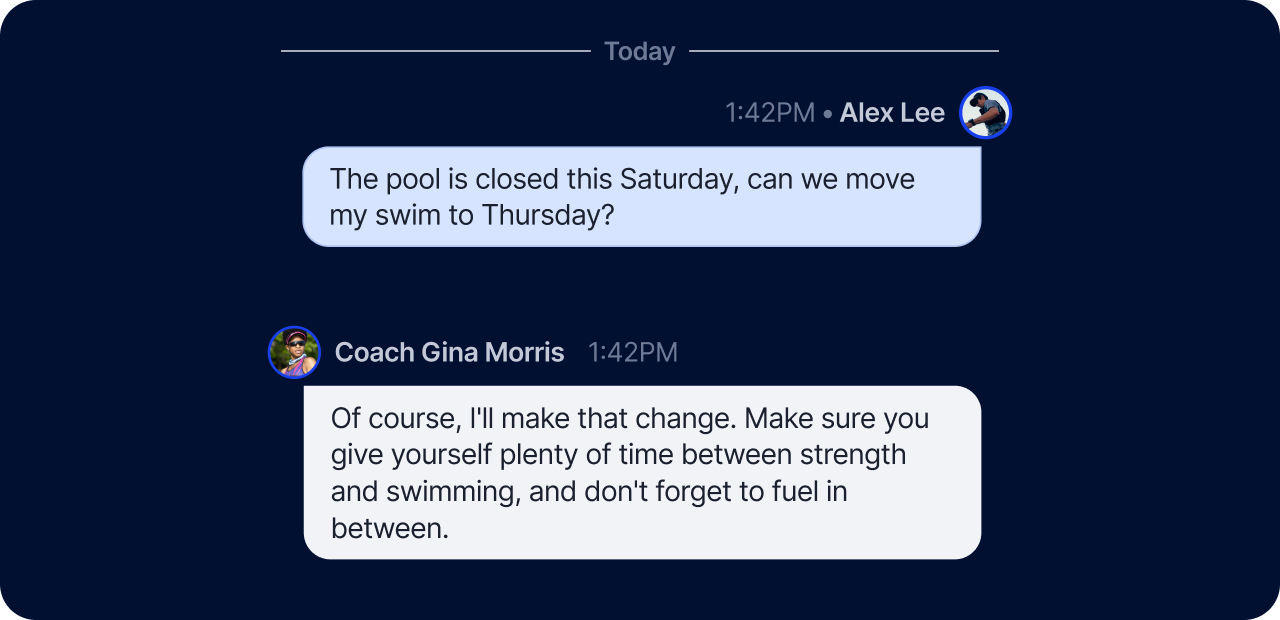
Coaching Tip → Use the TrainingPeaks Messaging feature to support open communication throughout training and give athletes an easy place to share post-race feedback and concerns.
Ask questions that leave room for the answer
The quality of the question matters. There is a considerable difference between “You blew up because you went too hard early” and “You weren’t able to follow at that point. Why do you think that was?”
The second question leaves some space.
The next question might be, “What do you feel contributed to that?” then perhaps, “Anything else?” and eventually, “Is there anything we could do differently together to help next time?”
The difficult bit can be what comes next:
Listen. Don’t immediately fill the silence.
The athlete’s explanation is not automatically the answer, nor is the coach’s first interpretation of the data. The task is to investigate.
Measure first, then investigate
Durability deserves the attention it is receiving. Understanding what an athlete can still produce after significant accumulated work can make testing and training more specific to the demands of competition, but the numbers aren’t a diagnosis.
They cannot always tell us whether the rider needed greater physiological durability, better fuelling, more confidence in the bunch, improved cornering, smarter positioning, or simply a different decision at an important moment.
Durability can tell us what happened. Coaching has to investigate why.
Use the data to identify where performance changed. Then ask well-timed, intelligent questions and give the athlete enough room to help you understand what was happening.
Sometimes the athlete is not failing to follow the plan. Sometimes something is preventing them from following it.
Finding out what that something is may be more valuable than another metric.
References
Kirkland, A. et al. (2023, Apr 16). An exploration of context and learning in endurance sports coaching. Retrieved from: https://www.frontiersin.org/journals/sports-and-active-living/articles/10.3389/fspor.2023.1147475/full
Sánchez-Jiménez, J.L. et al. (2026, Jan). Is intensity the most important factor in determining the amount of prior work accumulated that affects cyclists’ acute durability? A systematic review. Retrieved from: https://link.springer.com/article/10.1007/s00421-025-05885-0#citeas
VAN erp, T. et al. (2021, Sep 1). Maintaining Power Output with Accumulating Levels of Work Done Is a Key Determinant for Success in Professional Cycling. Retrieved from: https://pubmed.ncbi.nlm.nih.gov/33731651/


