



What if the single biggest nutritional difference between a professional cyclist and the rest of us wasn’t how many grams of carbohydrate they take on per hour during a race? What if it was something far simpler, and far more actionable, than that?
What if the pros just do a much better job of eating more on the days they train hard and less on the days they don’t?
It sounds almost too obvious to be interesting. But the data behind this idea is striking, and it points to something that most recreational riders get wrong week after week without ever realising it.
Where most cyclists go wrong with daily fueling
Earlier this year, sports scientist Jeff Rothschild and colleagues at Auckland University of Technology published a landmark observational study in the International Journal of Sport Nutrition and Exercise Metabolism. Over 12 weeks, 46 endurance athletes—triathletes, runners, and cyclists—logged every meal and every training session using smartphone apps. That produced 3,718 days of dietary data to work with—a far richer picture of real-world eating behaviour than any short-term lab study could provide.
The central question was deceptively simple: when an athlete trains harder, do they eat more carbohydrate? And when training is lighter, do they pull back?
At the group level, the answer was a tentative yes. Carbohydrate intake did tend to rise on heavier training days, driven mainly by session duration: the longer the ride, the more the athletes ate. On the face of it, the “fuel for the work required” principle seemed to be playing out in practice.
But Rothschild didn’t stop at the group average, and that’s where things got really interesting.
When he looked at each individual athlete separately, the picture changed dramatically. Participant-level correlations between daily training load and carbohydrate intake ranged from r = -0.42 to 0.83 (where -1 indicates an inverse correlation, 0 indicates no correlation, and 1 indicates a perfect correlation). In plain terms: some athletes showed a strong, sensible relationship between how hard they trained and how much they ate, but a large number showed almost none at all—or even ate less on their hardest days.
Only 26% of athletes demonstrated what the researchers classified as a moderate or stronger individual correlation, i.e. they ate more when training was long/hard. The remaining 74% did not align their nutrition as well with their training.
The “group average” was, in statistical terms, a bit of an illusion, a phenomenon researchers call nonergodicity: the group pattern doesn’t reliably describe any individual within it. Most of these recreational endurance athletes were eating in a way that was fairly consistent from day to day, regardless of whether Monday was a three-hour long ride or a rest day. The variation in carbohydrate intake was there, but for many athletes it was a small nudge rather than a genuine adjustment.
Average daily carbohydrate intake across the group sat at 3.9 g/kg—well below the 5-10 g/kg recommended for athletes training one to three hours a day.
What professional cyclists do differently
That paper sent us back to our own data.
At Hexis, we’ve spent several years helping pro teams fuel their riders and have accumulated the largest datasets of professional athlete nutrition and training in existence: about 50,000 days of logged food and training across hundreds of elite athletes. We pulled a comparable subset: 52 professional cyclists, representing 3,636 days of training and racing data.
We ran the same analysis.
The contrast was immediate and, frankly, striking.
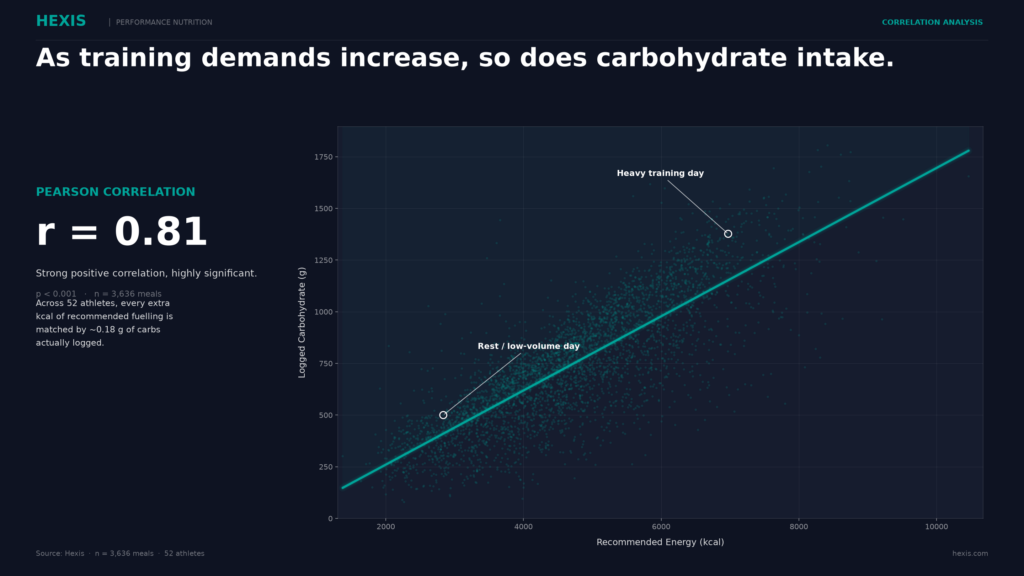
The correlation between daily training energy demands and carbohydrate intake in the professional group came out at r = 0.81, a strong positive relationship by any conventional standard. When we ran the same individual-level nonergodicity tests that Rothschild applied to his recreational cohort, we found no significant evidence of nonergodicity. The group correlation was a genuine representation of individual behaviour.
The pros weren’t just averaging out to look like they were periodising their nutrition, they actually were!
And the magnitude of the swing was substantial. On rest days or light recovery days, carbohydrate intake dropped considerably. On hard training days or race stages, it climbed to match demand. Average intake in the professional group sat between 10 and 12 g/kg, roughly double what Rothschild observed in recreational athletes. Some of that difference is simply because professional cyclists do an enormous amount of work.
But the more meaningful finding is the shape of the intake pattern: the pros are creating large, deliberate fluctuations day to day, consistently, across the whole group.
This isn’t just about race days either. The same pattern held across training blocks. When the work went up, the food went up. When the work came down, so did the carbohydrate intake. That rhythmic matching of energy-in to energy-out, day by day, session by session, appears to be one of the most consistent features of how elite cyclists fuel their training.
Why day-to-day carb adjustments matter more than you might think
The “fuel for the work required” framework has been a cornerstone of sports nutrition thinking for over a decade. The underlying logic is sound: carbohydrate availability during and around training influences cellular signaling, adaptation responses, glycogen synthesis, and the capacity to sustain back-to-back days of hard work. Getting carb intake right is part of how you build the metabolic machinery that makes elite performance possible.
What this data suggests is that professional cyclists aren’t just aware of this in principle, they’re living it in practice, with a consistency and precision that most recreational athletes don’t come close to matching.
For the recreational rider, the barrier isn’t usually understanding. Ask most committed cyclists whether you should eat more on a big training day and they’ll tell you yes without hesitation.
The gap is in execution. We’re creatures of habit. Most of us eat the same two or three things for breakfast, cycle through the same lunches and dinners, and make modest adjustments at the margins depending on how hungry we feel. The result is a diet that’s reasonably consistent across the week, which could keep your body weight stable, but is the wrong strategy if you’re trying to match your fueling to the actual demands of your training and enhance your performance.
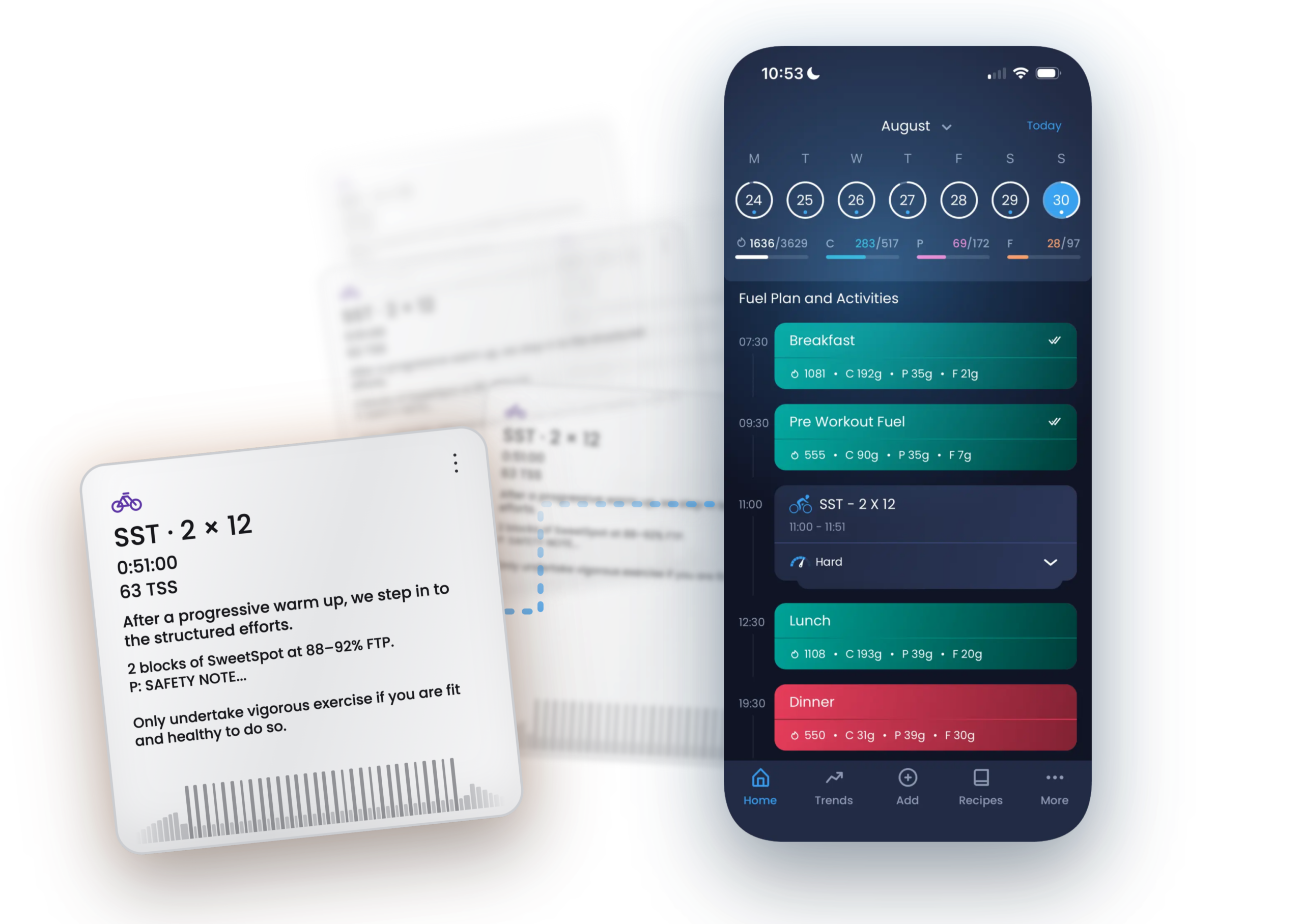
Training Tip → Sync a fueling app like Hexis with your TrainingPeaks account to get a personalised fueling strategy that matches daily intake recommendations to your scheduled sessions—plus day-to-day and block-to-block periodisation. Learn more here.
How to put “fuel for the work required” into practice
The good news is that acting on this doesn’t require a professional support team. Hexis integrates your training, lifestyle, and goals to ensure your nutrition actually supports your performance.
1. Anchor your carbohydrate intake to your training schedule.
Before the week starts, sync your training and look at what you have planned. Your hard days, long rides, intensity work, and back-to-back sessions should be your highest carbohydrate days. Your easy days and rest days should be noticeably lower. This isn’t about going hungry; total energy and protein can stay more consistent. Carbohydrate intake specifically needs to adjust with the workload.
2. Think in terms of the whole day, not just the ride.
Research shows that recreational athletes do adjust somewhat around the session itself—taking on more carbohydrate before and during harder efforts—but they miss the opportunity to optimise their total daily intake. The pros aren’t just fueling during the ride; they’re building high-carbohydrate days around their hardest training.
3. Make the swing meaningful.
Hexis’ Carb Coding System will structure your carb intake around your training to deliver your optimal fueling before, during, and after each training session. If you look at the professional data, the difference between a hard day and a rest day is substantial, not incremental. You don’t need to hit professional volumes, but the principle scales: the contrast between your high days and your low days should be real enough to matter physiologically.
4. Make recovery part of your fueling strategy.
Rothschild’s paper notes that restoring muscle glycogen fully after exhaustive training requires higher carbohydrate intake than most athletes achieve. On your hardest training days, the work doesn’t end when you get off the bike—the hours afterwards are where much of the adaptation is shaped, and carbohydrate availability in that window matters! So, fuel the adaptations you just put into action on the bike, and do it with carbs!
Closing the nutrition gap
The gap between recreational and professional nutrition isn’t really about access to exotic products or closely guarded secrets. It comes down to the disciplined, consistent application of a principle most of us already know: fuel for the work you’re actually doing. More on the days it’s hard. Less on the days it isn’t.
Simple in theory. Harder to execute than it sounds. But if the data is telling us anything, it’s that getting this right might be one of the most powerful levers available to the everyday cyclist who wants to get more out of their training.
References
Rothschild, J.A. et al. (2026, May 20). Dietary Intake of Endurance Athletes During 12 Weeks of Self-Selected Training: An Observational Study. Retrieved from: https://doi.org/10.1123/ijsnem.2026-0032


