



HYROX is all the rage these days. Since its 2017 debut in Germany, the hybrid race series has become the world’s fastest-growing fitness sport, hosting more than 100 events in 30 countries and drawing in new participants from a variety of sports, including distance running and CrossFit.
If I were 20 years younger, I’d probably be doing HYROX events myself, but as a middle-aged running coach I’m enjoying the sport at a remove by helping other athletes learn the best way to train for it.
The biggest mistake I see is a tendency to overestimate the strength dimension of these races and underestimate the endurance component. Strength is certainly important to successful HYROX racing, but endurance fitness and running ability are vastly more important, and the facts prove it.
What is HYROX?
HYROX is an indoor hybrid fitness race series that alternates 1-kilometer run segments with functional fitness stations, including:
- SkiErg
- Sled Push
- Sled Pull
- Burpee Broad Jumps
- Rowing
- Farmers Carry
- Sandbag Lunges
- Wall Balls
Why HYROX fitness is mostly endurance
Consider the sled push, which is considered the most strength-focused HYROX fitness station. It takes about two minutes for a competitive HYROX racer to complete this session—about the same amount of time it takes a competitive runner to complete an 800-meter race. We know that 55-65% of the energy consumed during a two-minute half-mile comes from aerobic metabolism, which suggests that a two-minute sled push is also predominantly aerobic in nature.
I’m not suggesting that a HYROX sled push is the same thing as an 800-meter run; the former clearly has a bigger strength component. What I am suggesting is that even the most strength-dominant segment in a HYROX event is not even close to being a pure strength test. An eight-second sled push is a pure strength test, but a two-minute sled push is a mostly aerobic test of muscular endurance.
The same goes for the sled pull, burpee broad jump, farmers carry, sandbag lunge, and wall ball stations. Combined with the purely aerobic SkiErg, row stations, and eight 1-kilometer run segments, the race as a whole becomes a cardiovascular challenge with a moderate strength demand.
Still not convinced? The following table shows split times and heart rate data from a HYROX event completed by an athlete I coach, Stephanie.
| Segment | Time | Average Heart Rate |
|---|---|---|
| Run 1 | 4:19 | 176 |
| Ski ERG | 4:23 | 169 |
| Run 2 | 4:04 | 180 |
| Sled Push | 1:46 | 175 |
| Run 3 | 4:18 | 182 |
| Sled Pull | 3:30 | 175 |
| Run 4 | 4:12 | 182 |
| Burpee Broad Jump | 3:39 | 186 |
| Run 5 | 4:17 | 180 |
| Row | 4:35 | 178 |
| Run 6 | 4:16 | 180 |
| Farmer’s Carry | 1:41 | 184 |
| Run 7 | 4:21 | 181 |
| Sandbag Lunges | 2:58 | 179 |
| Run 8 | 4:36 | 180 |
| Wall Balls | 3:49 | 187 |
Notice that Stephanie’s heart rate is fairly stable throughout the race. The numbers might seem high, but her lactate threshold is also high—180 BPM, to be exact—so what you’re looking at is a steady-state threshold effort from start to finish.
The average heart rate values mask fluctuations that occurred during transitions between segments and brief rest pauses Stephanie took during the completion of certain fitness stations (such as sled pulls and wall balls), but overall the data isn’t much different from what we’d observe in a half marathon.
HYROX training: all about balance
The fact that a HYROX race is fundamentally an endurance event has two key implications if you want to train for one:
1. Prioritize running in your weekly schedule.
In the race we just analyzed, Stephanie spent 53.5% of her time on the clock running, which is typical. When I coach athletes for HYROX events, I have them spend about half of their total weekly training time running.
That seems radical to some, but there’s precedent: in triathlon, the bike leg takes up about half the race, and well-coached racers spend about half of their weekly training time in the saddle.
Keep in mind that the aerobic fitness you build through running doesn’t just help you run better—it also improves your fitness station performance by increasing muscular endurance.
Below are two suggested weekly workout schedules, one for beginner-level HYROX athletes and one for advanced competitors. Note that compromised runs alternate short bouts of fitness-station work with running segments, so these sessions are approximately 50% running.
| Suggested Weekly Training Schedule for Beginner HYROX Athletes | ||||||
|---|---|---|---|---|---|---|
| Monday | Tuesday | Wednesday | Thursday | Friday | Saturday | Sunday |
| Rest | Run | Station Work | Run | Strength Training | Run | Compromised Run |
| Suggested Weekly Training Schedule for Advanced HYROX Athletes | ||||||
|---|---|---|---|---|---|---|
| Monday | Tuesday | Wednesday | Thursday | Friday | Saturday | Sunday |
| Rest | Run | Run | Run | Strength Training | Run | Run |
| Station Work | Strength Training | Compromised Run | Station Work | |||
2. For max performance, balance your training intensities correctly.
It is well established that endurance athletes across sport disciplines get the best results when they spend about 80% of their weekly training time at low intensity (i.e., below 75% of maximum heart rate) and the remaining 20% at moderate to high intensity, and I believe that HYROX athletes should do the same.
In my experience, the overwhelming majority of HYROX racers don’t do nearly enough low-intensity training. To be fair, most runners also don’t do enough low-intensity training, but in their case it’s unintentional: they’re doing their “easy” runs too fast, thinking they’re at low intensity when it fact they’re at moderate intensity, whereas HYROX athletes simply don’t plan enough easy runs.
In particular, those who come to the sport from gym-based training backgrounds (CrossFit, etc.) assume that a “go hard or go home” mentality and a heavy emphasis on high-intensity intervals are the best recipe for improvement, when in reality they’re an express train to stagnation.
Plan your weekly HYROX run training so that you spend about 80% of your running time in Zones 1 and 2 and 20% in Zones 3 to 5. Designating two out of every three runs as easy will get you pretty close, remembering that even hard runs (high-intensity interval workouts, tempo runs) include time at low intensity.
Your aerobic station work should feature the same 80/20 intensity balance as your running. Technique-focused station work and standard strength workouts with plenty of rest between sets do not count toward calculations of intensity balance, but any station work that keeps the heart rate elevated does.
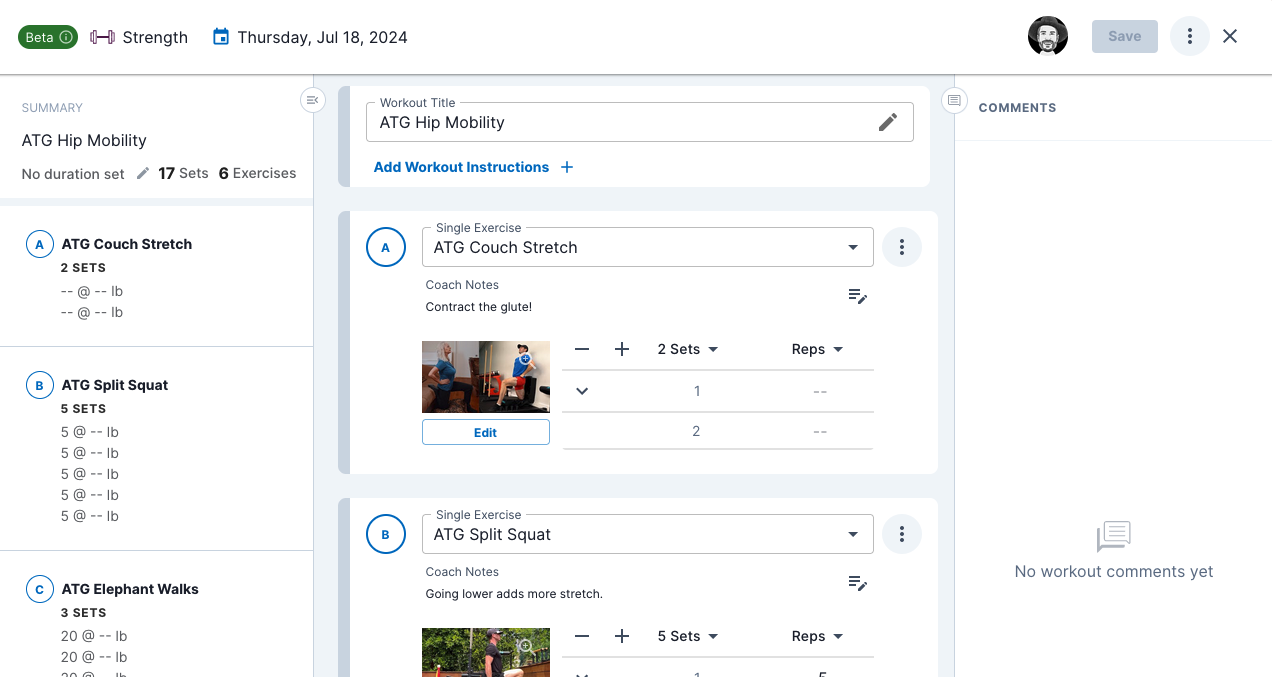
Training Tip → Use TrainingPeaks’ Strength Workout Builder to log your strength sessions right alongside your endurance workouts, making it easy to track your total weekly time-in-zone ratios across all training.
Try our HYROX training plans
The simplest way to achieve the optimal balance of workout types and intensities in HYROX training is to follow a program designed by a coach who understands the endurance-based nature of these events. Try one of the new 80/20 Endurance HYROX/Hybrid Racing plans:



While other athletes hold themselves back with a “go hard or go home” mindset and too many intervals, you can get a leg up on the competition by treating HYROX as the endurance competition it truly is.


