



At the Tour de France, every rider has a different job to do. Climbers need durability. Sprinters need Peak Power. Breakaway riders need the ability to survive repeated stress. Lead-out riders need the neuromuscular capacity, positioning skill, and high-speed repeatability to deliver when the race is at its most chaotic.
For Team Cofidis, TrainingPeaks helps connect those rider profiles to the demands of a three-week Grand Tour. From planning workload and monitoring FTP, durability, Functional Reserve Capacity (FRC), Peak Power, and TSS to using the Performance Management Chart to adjust daily training load, the platform helps the performance team prepare each rider for their specific role.
That’s why over 80% of the teams on the start line in Barcelona trust TrainingPeaks to build, manage, and optimize their training data.
With We Speak Peak, TrainingPeaks is shifting the Tour de France conversation beyond race results to spotlight the coaches and performance teams behind cycling’s biggest stage. In this Q&A, Cofidis Head of Performance Mattia Michelusi explains how Team Cofidis, the Stage Hunters, uses TrainingPeaks to prepare climbers, sprinters, lead-out riders, and breakaway specialists for the unique demands of the Tour de France.
Meet Team Cofidis, the Stage Hunters
“We have Stage Hunters, and their special ingredient is FRC. Our lead‑out riders are a combination of FRC, Peak Power, and the skill of riding in the bunch at really high speed. Our breakaway guys survive on TSS and Durability. And our sprinter’s Peak Power is the right ingredient to be able to win a sprint.”
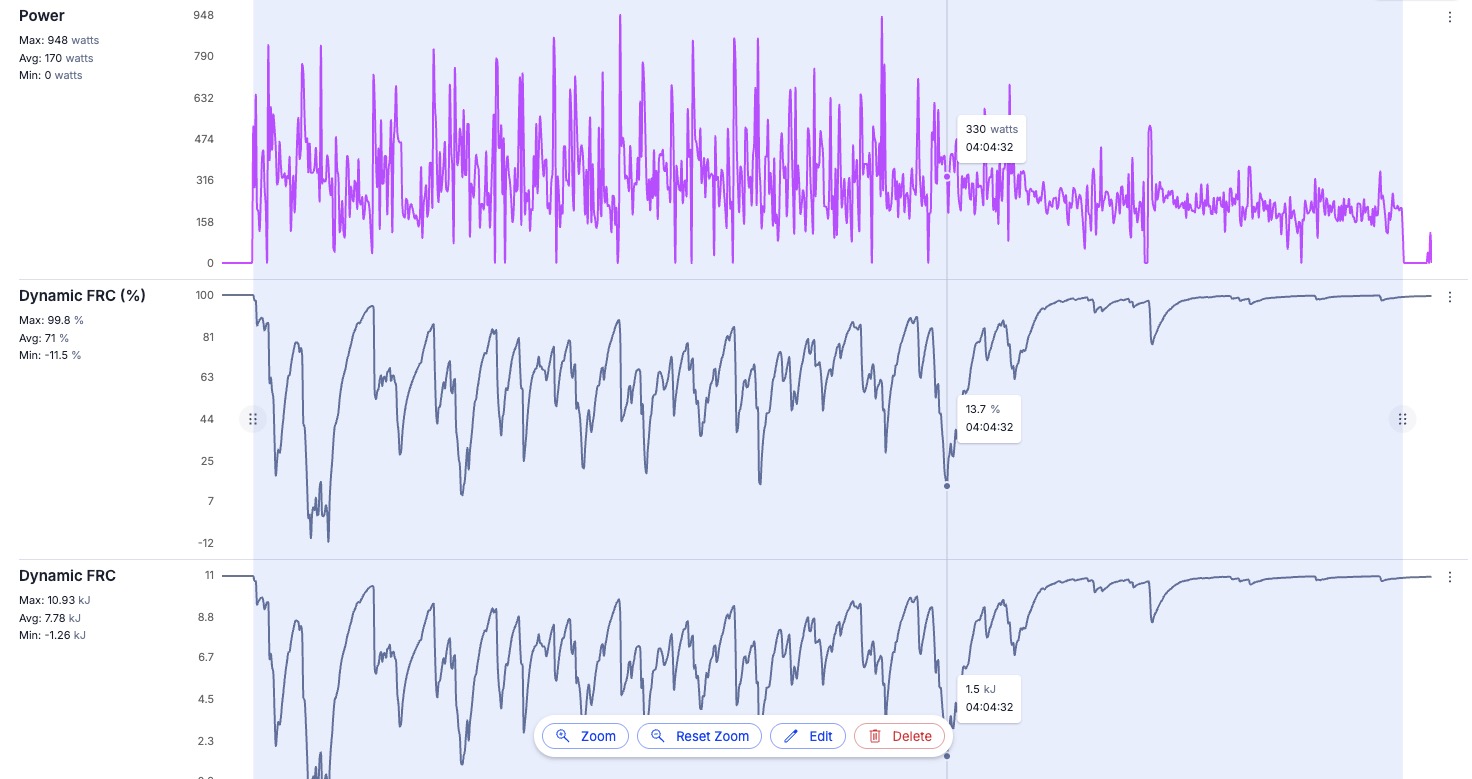
Cofidis uses dFRC in TrainingPeaks to see how much above-threshold capacity a rider has left after repeated surges, climbs, and attacks. You can use it, too, to understand when you’re burning matches, when you’re recovering them, and whether you still have enough left for the next big effort. Learn more about dFRC here.
Q: How does your team specifically utilize TrainingPeaks to prepare for the unique demands of the Tour de France?
A: We use TrainingPeaks to optimally plan the workload required to handle a three-week stage race like the Tour de France, adapting to each rider’s characteristics.
With our climbers, the goal is to improve metrics like FTP and durability, so they can manage fatigue accumulation in the high mountain stages.
With our sprinters, our focus is on maintaining the neuromuscular components needed to perform at their best in sprints, without incurring a performance decrement on the hardest mountain stages.
At the Tour de France, we face high temperatures. That is why, in preparation for the Tour de France, it is important for us to monitor core body temperature using the CORE sensor.
Training Tip → Connect devices such as your CORE sensor to TrainingPeaks to analyze physiological metrics such as heat strain, sweat rate, respiratory rate, and more. Analyze 360 allows you to layer these metrics, create custom laps from any portion of a session, and evaluate how physiology, environment, and intensity combine to influence performance.
Q: What specific data metrics or tools within TrainingPeaks are absolute keys to your team’s Grand Tour preparation?
A: We rely on three TrainingPeaks metrics.
First, FTP (Functional Threshold Power) and durability are essential for our climbers to model how fatigue accumulates across repeated mountain stages.
Second, Peak Power (Pmax) and Functional Reserve Capacity (FRC) allow us to monitor our sprinters neuromuscular characteristics, ensuring they can still deliver maximal efforts after the daily accumulating workload of each stage.
Third, the Performance Management Chart (PMC) helps us adjust the daily workload.
Q: What are the key physiological indicators to you as a coach that your athletes are peaking and preparing in the right way?
We monitor several key physiological indicators.
First, we look at the heart rate relative to power at sub-threshold efforts, this allows us to monitor if the endurance efficiency has improved.
Second, we track Heart Rate Variability (HRV) trends with our ULTRAHUMAN ring.
Third, we try to assess Training Stress Balance (TSB) by adjusting the daily workload.
Fourth, we perform regular lactate monitoring at submaximal and threshold intensities. In particular, for our climbers, we also monitor durability metrics.
Last but not least, the rider’s feeling, their subjective perception of readiness, motivation, and leg freshness, remains an indispensable qualitative indicator.
Explore more coach Q&As, listen to exclusive interviews, and ride every route virtually in the We Speak Peak Tour Hub.


