



This time of year, pro endurance athletes flock to training camps in destinations like southern Spain, Cyprus, South Africa, Thailand, or the Canary Islands—seeking either warm weather, high altitude, or both—for focused eat-sleep-train blocks.
But what if traveling isn’t an option? What if you need to stay home, whether you’re training through cold weather in the northern hemisphere or managing your off-season in the south? Here’s the good news: you can absolutely train like a pro from home.
Just look at Lionel Sanders, the Canadian pro who finished second at Kona in 2017. He’s built an entire career logging most of his sessions on a treadmill and bike trainer, often on his own balcony. And he’s not alone.
Training from home comes with real advantages: your own bed, no travel costs, no time lost to airports and logistics. Plus, a DIY home camp can add serious variety to your training year-round, turning indoor sessions from monotonous to genuinely engaging.
And if you’re fortunate enough to live at altitude, you’ve got a built-in performance advantage right outside your door—no travel required.
Ready to design your own? Here’s your step-by-step guide.
Step 1: Define your time frame.
Wondering whether to commit to a full week or just a long weekend? The beauty of the spiral training cycle structure outlined here is its flexibility: you can do either by adjusting the training load accordingly. You can even stack two or three consecutive long weekends together for a serious boost to your fitness.
This format works across your season: it’s effective as foundational training during your base-building phase and equally valuable during final race preparation in those critical 5-6 weeks leading up to your event.
Step 2: Define your objective.
Deliberate practice requires a clear target. Set a specific, measurable objective for your camp—whether that’s improving functional strength, building base endurance, or developing power endurance.
Also, quantify your goals: lift 150% of your bodyweight with a hex bar by the end of three camp cycles, hold a 5:30/km pace for two hours in Zone 2, or sustain 250 watts for 30 minutes. Concrete goals create concrete progress.
Training Tip → Keep all of your training in one place (including strength workouts) to make sure all the work you’re doing is aligned toward your main goal. TrainingPeaks is a great place to do this (plus it’s fun to check off each exercise!)
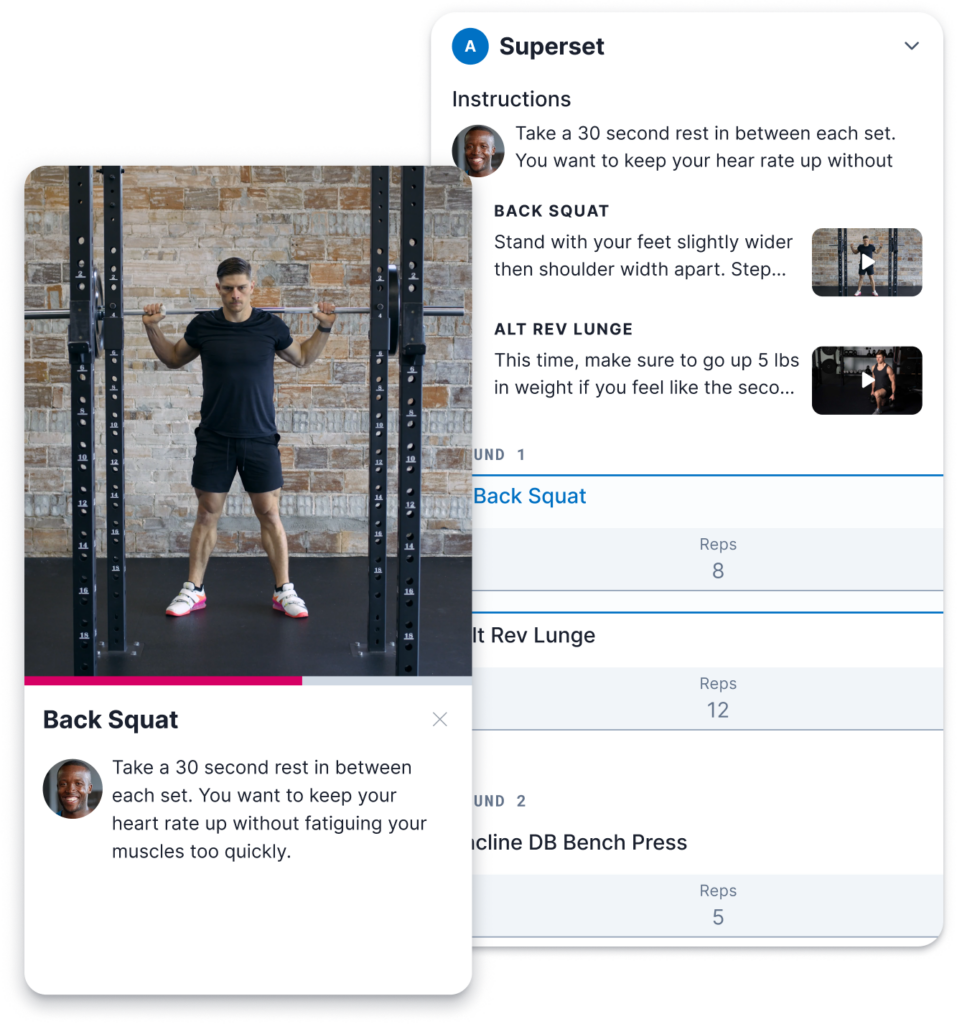
A note on strength training:
For many endurance athletes, the weight room can feel like foreign territory. If strength training is new to you, start by working through this strength training guide or find a program designed by an experienced coach who understands endurance athletes’ specific needs.
Step 3: Design a progressive load structure.
Calculate your average weekly TSS from the past four weeks—this becomes your total load for a 3-day weekend camp. Distribute this load across the three days using a progressive structure: 25%-35%-40%.
For example, with a 500 TSS average, you could plan for 125 TSS on Friday, 175 on Saturday, and 200 on Sunday. If you’re training primarily in Zone 2, that translates to roughly 2.5 hours Friday, 4.5 hours Saturday, and 5 hours Sunday. Higher-intensity sessions would reduce these durations. And yes, Monday should absolutely be a rest day.
For a week-long camp, structure it as two 3-day blocks with a rest day in between, following the same spiral pattern. Use 70% of your 4-week TSS average for the first block and 80% for the second. Using our 500 TSS example, your week totals 750 TSS, distributed as: 88 – 130 – 150 – 0 – 100 – 140 – 160.
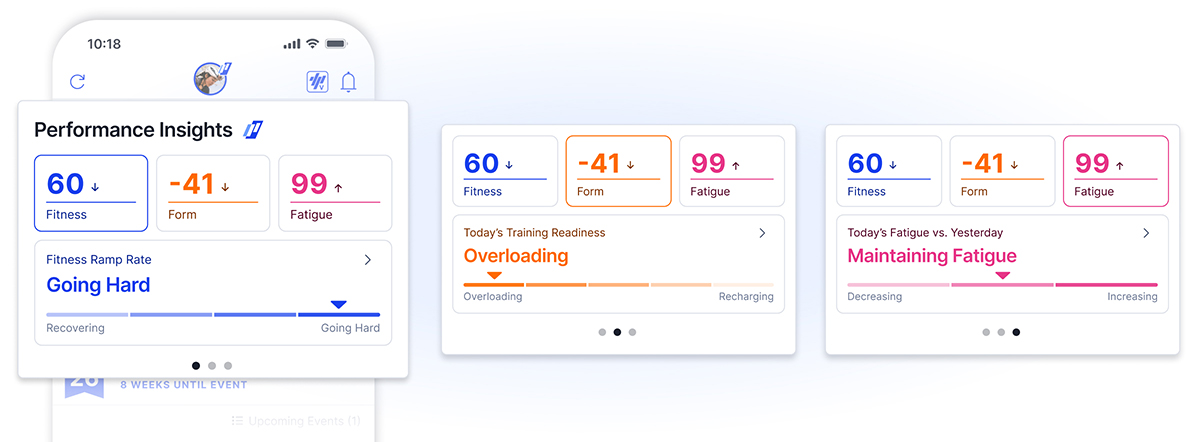
Training Tip → Training Stress Score might seem complex at first, but once you grasp it, it becomes an invaluable tool for tracking your cumulative training load. TrainingPeaks’ Performance Management Chart uses your Training Stress Score, Chronic Training Load, and Acute Training Load to calculate your Training Stress Balance (Form)—giving you a clear picture of your recovery status and readiness to train.
Performance Insights makes it easy to see your Training Stress Balance (aka, Form). In this example, the athlete’s data indicates that they are overloading — a day off may be the smart move.
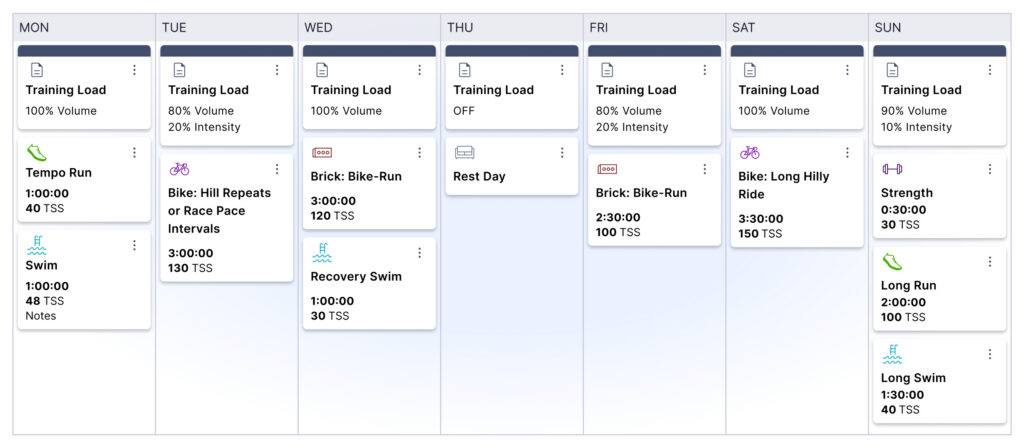
Step 4: Allocate volume, intensity and workout types.
Here’s an example of what a week of training can look like. Plan it out in advance so you don’t have to think about it during your focused week, and tracking compliance can help you determine whether it was a success of it adjustments needs to be made.
Step 5: Invite friends and family to train with you.
This is where a home camp truly shines: you stay connected instead of disappearing into a training cave. Get creative with integration—have your kids set up transition zones for brick workouts, recruit your partner to follow your runs on a bike (or e-bike), or better yet, train together if they’re up for it. Staying social keeps you motivated and keeps your relationships healthy.
Training Tip → Keep it social with group rides, challenges, and workouts in TrainingPeaks Virtual. Explore the hub for current events or create your own.

Step 6: Do grocery shopping and cooking in advance.
Higher training volume means higher fuel requirements. Plan ahead and stock up on everything you’ll need. Batch-cook staples like beans, lentils, and quinoa for nutrient-dense salads throughout the week.
Prepare portable snacks—rice balls, homemade energy bars—for those long rides. Remember: your nutrition strategy is your race strategy, especially for long-course racing. A home camp gives you the perfect opportunity to test different fueling approaches in a controlled environment.
Training Tip → Many third-party nutrition apps sync with TrainingPeaks to give you personalized nutrition based on your training. Some include:
Step 7: Be smart.
The temptation is big to go and kill yourself on Day 1 of a training camp—but it’s a rookie mistake! Generally, for 80% of your training, you should finish feeling like you could continue for at least another 30 minutes. In a camp setting, progressive fatigue management is everything. Build gradually, respect recovery, and aim to finish the camp tired but not destroyed—you should be able to resume normal training after some recovery days.
Plan a lighter week following your camp: start with one or two complete rest days, then stick to base endurance work for four to five days. After this recovery cycle, step up to the next level by adding 10-20% to your weekly TSS. Repeat this pattern consistently, and you’ll arrive at race day in peak form.


