



The cycling and triathlon training landscape has changed dramatically in recent years, thanks to the rise of more accurate athlete data from heart rate monitors, HRV tracking, power meters, and other wearables. As the quality of training data has improved (and the tools used to analyze it have become more advanced) many coaches can now assess key physiological markers without relying as heavily on traditional lab testing.
VO2 max and blood lactate testing once required athletes to visit a university or performance lab. Now, coaches can often use power meter data collected over time to estimate many of the same physiological insights, helping athletes save time, reduce cost, and make smarter training decisions.
What Is a VO2 Max Test?
A VO2 max test measures the maximum amount of oxygen your body can use during intense exercise, typically performed in a lab using a mask that analyzes inhaled and exhaled gases.
This test can show:
- Your VO2 max value (ml/kg/min)
- Aerobic vs anaerobic thresholds
- Efficiency metrics like respiratory exchange ratio (RER)
In theory, a higher VO2 max means greater aerobic capacity and performance potential.
What Does a VO2 Max Test Actually Tell You?
A lab test provides high-resolution physiological data, including:
- Oxygen consumption limits
- Heart rate zones tied to metabolism
- Power or pace at key thresholds
This can help cyou understand whether training is improving physiology, where your aerobic ceiling is, and how efficiently you use oxygen
The Limitations of a VO2 Max Test
A VO2 max test can provide detailed physiological data, but it comes with a few important limitations, especially when it comes to applying those insights to real-world training.
First, it’s a single snapshot in time. Your VO2 max value reflects how your body performed on one specific day, under controlled conditions. It doesn’t account for normal day-to-day variability like fatigue, stress, or training load, which can all influence performance.
Second, the headline VO2 max number has limited practical use on its own. While a higher VO2 max suggests greater aerobic capacity, it doesn’t directly tell you how to train or what’s limiting your performance. Two athletes with the same VO2 max can perform very differently depending on factors like efficiency, durability, and threshold.
Even the additional lab metrics, like expired CO2 or Respiratory Exchange Ratio (RER), require careful interpretation to be useful. Without context, they don’t always translate cleanly into actionable training decisions.
Finally, VO2 testing is time-consuming, expensive, and difficult to repeat regularly. Because of this, it’s hard to use as an ongoing feedback tool.
In contrast, data collected from tools like power meters, pace, and heart rate over time can provide a more complete and actionable picture of performance—showing trends, identifying strengths and weaknesses, and helping guide training decisions without the need for a lab test.
A Better Approach: Use Ongoing Data
Instead of chasing a single VO2 max number, focus on:
- Peak efforts (e.g., 5-minute power/pace)
- Trends over time
- Progress across durations
For example:
- A 5-minute max effort can approximate VO2 max intensity
- Tracking this regularly shows whether fitness is improving
This approach is:
- More practical
- More repeatable
- More relevant to performance
How Power Curves Can Replace VO2 Max Testing
Power curves can give you a more useful picture of fitness than a single VO2 max test. A mean max power curve shows the highest average power you’ve produced across a range of durations, using your actual training and race data to reflect how your fitness shows up in the real world. So instead of relying on one lab snapshot, you can see how you perform across short efforts, sustained efforts, and everything in between.
That is what makes power curves so valuable. They can help you spot strengths, identify weak points, and see whether your training is working over time. If your curve starts to rise in the durations that matter most for your event, that is a clear sign you are moving in the right direction. TrainingPeaks was one of the first platforms to introduce power curves, making it easier for athletes to compare workouts, analyze progress over different time ranges, and turn ride data into something actionable.
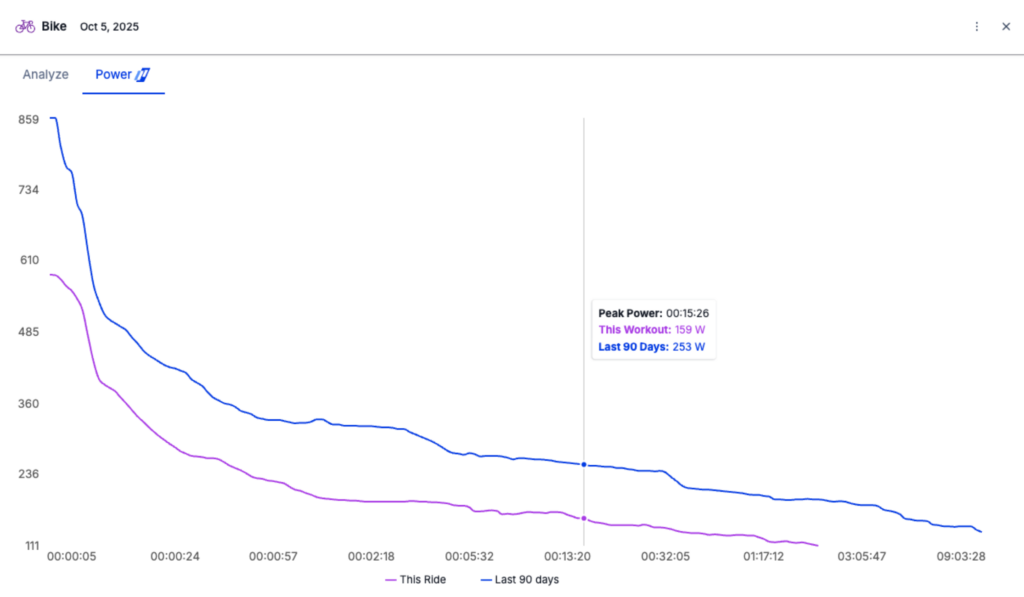
Analyze 360 takes that a step further. In addition to the commonly tracked durations, it expands the power curve view to include hundreds of additional data points and a more detailed power profile. That gives you a more precise look at how your fitness is changing and makes it easier to focus on the exact durations that matter most for your goals.
In other words, power curves help shift the focus away from chasing one lab number and toward understanding the bigger picture of your fitness. They make it easier to see what kind of athlete you are, where you are improving, and what to work on next.
How Will You Use the Data?
Before booking a VO2 max or blood lactate test, ask yourself one simple question: Will this data actually change how you train? The value of any test comes down to whether the results are actionable, AKA whether they give you insight you can use to make better day-to-day decisions.
In many cases, broader performance trends are more useful than a single lab metric. For example, if you can produce strong power early in a ride but fade significantly later on, that suggests a limiter such as fatigue or durability — something a traditional lab test may not fully capture. Metrics like these can help you better understand how your fitness holds up in real-world training and racing.
It’s also worth asking whether there are bigger opportunities to improve first. Would better recovery, more consistent fueling, smarter pacing, or better use of your training data have a greater impact on performance? And if you did get new VO2 max or lactate numbers, how would they actually change your training?
If your goal is to train more effectively, the best investment is often not more testing, but better tools and better guidance. A reliable power meter and a knowledgeable coach can give you more practical insight, better training decisions, and stronger results than a one-time lab test alone.


