



Ultramarathon runner Will Murray didn’t have a course record-setting victory at the Javelina Jundred 100 in his plans for 2025. It was a hard-earned opportunity to transform a series of unfortunate events into a resounding success. We initially built his season around peaking for the 2025 Western States Endurance Race in June. However, that race had to be stripped from his schedule after a first-ever episode of atrial fibrillation just three weeks before the race, followed by a broken ankle a week and a half out. But Will, a 30-year-old math teacher, was unfazed by the need for creative problem solving. Here are some insights into Will’s unorthodox training for the 2025 Javelina Jundred.
Cycling: Will Murray’s Training Superpower
Lots of ultramarathon runners incorporate cycling into their training. The difference with Will Murray is that he was an elite-level competitive cyclist in college, and he continued cycling long distances even as he transitioned to competitive trail running. That is an important distinction for a number of reasons.
1. Transferability
Cycling and running are both endurance sports that primarily use the lower body for propulsion. Both stress the cardiovascular system, develop the aerobic system, and benefit from adaptations that promote fat oxidation and the ability to consume and utilize large volumes of carbohydrate. You would think there would be extensive transferability between training on the bike and training on your feet. However, economy is crucial for both cycling and running, and cumulative training volume is one of the most important factors for optimizing economy in either discipline.
Experienced runners who are relative novices on the bike suffer from a significant mismatch in economy between running and cycling. During a long ride, they use more energy, consume more oxygen, and create more fatigue than a highly-adapted cyclist. Because of his extensive experience in cycling, there’s less of a differential between the stress Will accumulates on the bike and on the run, so I’ve been able to use the two modes of exercise to complement each other. In other words, his Zone 2 intensity on the bike is similar to his running Zone 2, and he can do either or both for several hours at a time.
2. Bike-Run Brick Training
Triathletes are very familiar with bike-run brick workouts, which are sport-specific sessions that incorporate a run immediately after a ride, as you would during a triathlon. In Will’s training, I used “bike-to-run” brick workouts to accumulate more hours of time at intensity with less muscle damage compared to ultra-long training runs.
The goal for Will’s bike-run brick workouts is to achieve a physical, emotional, and nutritional state similar to running five hours (i.e., depleted glycogen stores, mental fatigue, and hours of steady sweating, fluid replenishment, and consumption of high volumes of carbohydrates) without the muscle damage of running five hours. The subsequent run off the bike then becomes very specific, meaning it simulates putting Will at about 100 km into an ultra. A fit runner can run fast for two to three hours. I wanted to improve durability so Will could still work at his aerobic threshold after 10 hours of running. The bike-to-run allowed us to accomplish this without affecting the quality of the run training.
We incorporated “bike-to-run” brick workouts throughout the year. Further out from goal events, the workouts featured much longer rides with shorter and/or easier runs after. Closer to goal events, the rides became shorter but the intensity increased to Zone 3 (i.e., aerobic tempo, sweetspot), including some high-torque intervals to recruit more motor units and fast-twitch muscle fibers, and the runs off the bike were more specific to the demands of his particular goal event.
The Data Tells The Story
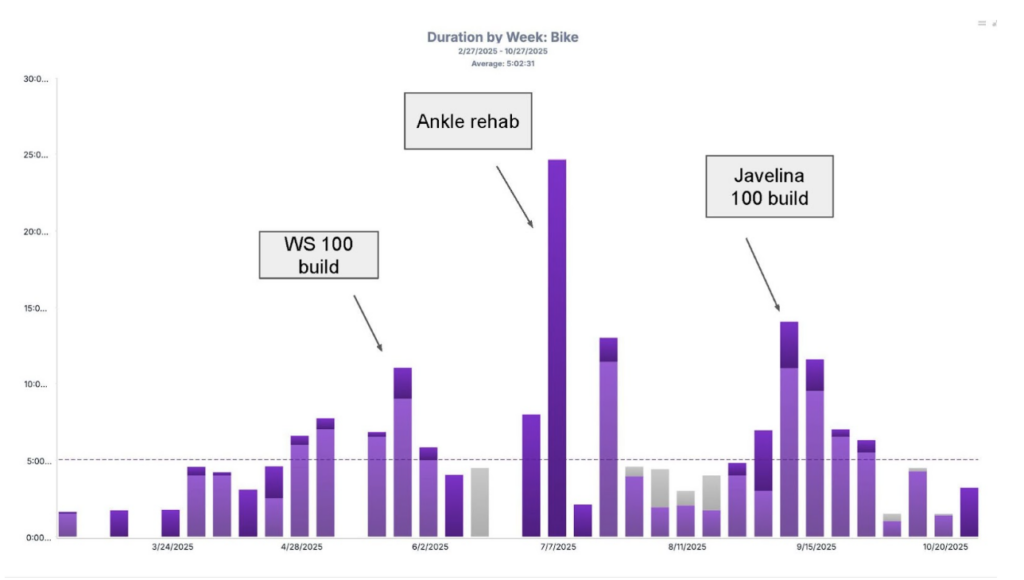
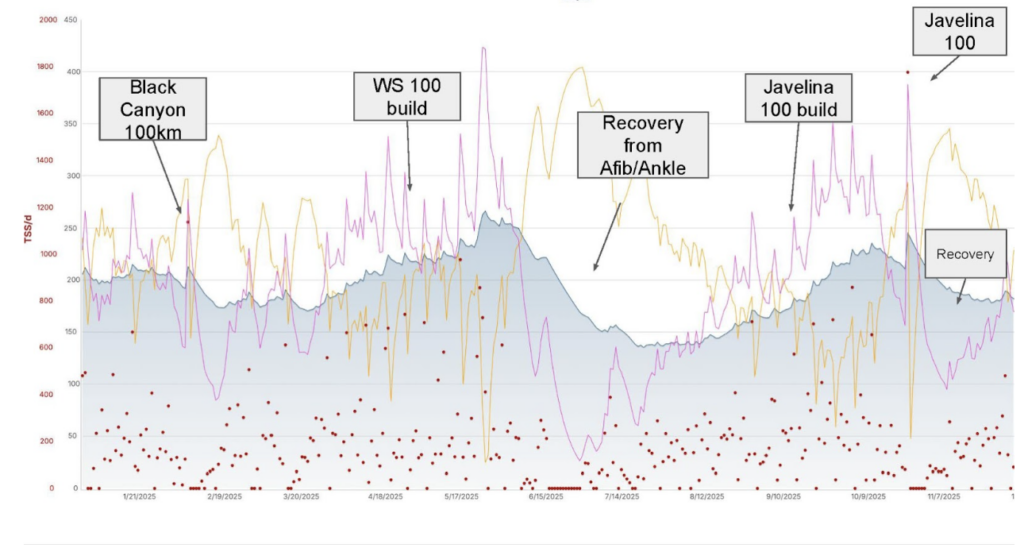
The images below illustrate the positive role cycling played in Will’s 2025 season. In the chart depicting cycling hours per week, you can see that Will rode approximately six to 10 hours per week. After he broke his ankle and missed Western States, his cycling hours dramatically increased, hitting 25 hours in early July. As you can see in his Performance Management Chart (PMC), that spike in cycling hours caused a dramatic increase in Acute Training Load (ATL), which arrested the drop in his Chronic Training Load (CTL) and provided a launch pad for rebuilding his running form once his ankle healed.
Finally, you can see that we increased his weekly cycling hours in the lead up to Javelina to elevate his CTL to the level we felt was necessary for a winning performance in Arizona. You may also notice that his ATL was quite high and his Training Stress Balance (TSB) was quite low during the final training block before Javelina. Admittedly, the ramp-up was aggressive because his timeline was shortened, but this was where interpretation was important. His ATL was high, but cycling contributed a lot to his daily Training Stress Scores. Because cycling causes less muscle damage than running, his running workout performances, heart rate variability, and subjective feedback indicated that he was handling the training load better than the PMC suggested.
3. Intuitive Pacing
Although both cycling and running can generate a lot of data for post-workout analysis, cyclists have access to more accurate and meaningful real-time data than runners do. When he was a competitive cyclist, Will used a power meter and a heart rate monitor. Crucially, though, he learned what coaches should try to teach every athlete: how to use data in training to learn how to compete without it.
Will rode and raced with power and heart rate long enough to learn how to gauge his intensity without looking at a head unit on his handlebars. As an ultrarunner, this is important because it means he can ride and run using the same intuitive, low-tech, yet remarkably accurate tool for gauging exercise intensity: the Rating of Perceived Exertion. By collecting blinded data during workouts, we discovered that Will’s RPE is so well calibrated between cycling and running that he can adjust his energy intake as a rough percentage of energy expenditure with surprising accuracy.
4. Efficient Gut Training
Rides up to 200 miles in length provide a lot of time for extensive gut training, and it is easier and more convenient to consume well over 100 grams of carbohydrate per hour while riding compared to running. The mechanical strain within the gut is also much greater while running, which contributes to gastric distress even with lower volumes of food and fluid. By focusing on gut training during long rides, Will has been able to dramatically increase the volume of carbohydrate he can consume while running. During parts of the 2025 Javelina Jundred, he consumed more than 100 grams of carbohydrate per hour.
Broken Ankle Bonus: The Benefits of Being a Spectator
When Will broke his ankle before Western States, he decided to attend the race as a spectator anyway. As his coach, it was great to spend some time with him that wasn’t directly related to his training or a competition. Coaching is a relationship, and it’s a real gift whenever you can spend quality time with an athlete and really get to know them better. I attended Western States to support athletes I coach and as a member of the CTS Athlete Support Crew. Together, 16 CTS Coaches spread out and moved among the Western States aid stations to provide comprehensive support to CTS Athletes as they progressed toward the finish line.
Kiddie pools full of ice were one of the innovations we introduced during Western States. The idea was to quickly reduce skin temperature and thoroughly douse the athlete with cold water. It looked like a gimmick, but it was based on solid science and a case study with a CTS Athlete in Arizona. Using core temperature pills during hot weather training runs, the athlete tried multiple cooling interventions (e.g., drinking cold water, slowing down, ice-cold shower, etc.). The core temperature sensor indicated that the largest core temperature drop resulted from 10-30 seconds of a cold shower. More importantly, it took between 30 and 60 minutes for core temperature to return to the pre-shower level. Pausing for up to 30 seconds during a race is a big deal, but the case study showed that the benefits were worth the time. The ice-filled kiddie pools were the practical solution for Western States, and they worked. Soon, athletes were eagerly anticipating the next opportunity to take a dip.
As a spectator, Will witnessed the entire process. By the end of the race, he was completely on board for incorporating ice dips during the Javelina Jundred. Buy-in is crucial for elite athletes, who have been taught from early on to stick with the training, nutrition, equipment, and ideas that helped them become elite athletes in the first place.
Does Will’s Success Mean Ultrarunners Should Incorporate Cycling Training?
Not necessarily. What I’ve learned through coaching Will Murray and many other athletes is that your training history may provide a competitive advantage you haven’t tapped into. Cycling works as a significant component of Will’s training because he spent years training and racing as an elite cyclist. Will rode his bike 2,300 miles in southern France, navigating with a paper map, with neither GPS nor phone, just for fun. After he stopped racing, his long rides were still up to 200 miles long.
That said, there are compelling reasons why cycling could be a beneficial training tool for ultramarathon runners. It’s low-impact, and as long as you have a good bike fit (tip: go get a professional bike fit!), it has a low prevalence of overuse injuries. Cycling induces far less muscle damage than running, even during high-intensity cycling, meaning you can accumulate more time at intensity and need less recovery time before your next running workout. And it is absolutely beneficial in terms of aerobic conditioning and optimizing fuel utilization (both carbohydrate and fat). To learn how to incorporate cycling workouts into your running training, I previously wrote this article for TrainingPeaks, too.


