



You can train for months and months and visualize it perfectly in your head, but race day rarely ever goes exactly to plan. Most endurance athletes know this. It’s practically a rite of passage.
The Tour de France is no exception to that rule, even for the most trained athletes. Over three weeks, riders grind through 21 stages of heat, mountains, accumulating fatigue and race-decisions that shift with every climb, crash and attack.
Making it through the Tour requires more than fitness alone – it takes careful recovery, long-term planning, the ability to dig deep when you’re tired, and adaptability. That’s why Team Astana goes beyond developing fit athletes and instead builds athletes who are durable and able to adapt on a dime.
Here’s how they do it.
Training for more than one great day
For WorldTour teams, it’s not race day. It’s race month.
The demands of a three-week Grand Tour are too complex to evaluate with a single metric, workout, or one-dimensional plan. Team Astana looks at the big picture, using TrainingPeaks to integrate long-term planning with real-time daily data analysis with the Performance Management Chart (PMC).
Actually, Astana uses TrainingPeaks to monitor every phase of training leading up to the Tour. It’s used to individualize training loads, monitor fatigue, and optimize recovery. Just as importantly, it provides coaches, sports scientists, and riders with an integrated performance “hub” where decisions are informed by both objective data and subjective athlete feedback.
Building durable athletes
Astana doesn’t focus on building athletes with the highest peak numbers. They focus on building athletes who are the most durable.
In the Tour de France, durability means being able to perform even after hours, days and weeks of racing. That’s because the most defining moments of the Tour don’t happen on fresh legs — they happen late in the race.
The data behind adaptability and durability
Astana looks at each rider through two lenses: what their role demands and how well their performance holds up under fatigue. The Performance Management Chart is one of the team’s most important tools because it helps coaches monitor training, fatigue, and recovery across the entire roster.
Within TrainingPeaks, Astana closely tracks metrics like:
- TSS (Training Stress Score)
- CTL (Chronic Training Load)
- ATL (Acute Training Load)
- Aerobic Decoupling (pace to heart rate or power to heart rate)
- Functional Reserve Capacity (your anaerobic capacity)
For climbers and GC riders, that means repeatability and fatigue resistance during sustained high-output efforts. Can they respond again on the final climb?
For stage hunters and classics-style riders, the focus shifts toward anaerobic contribution, repeat accelerations, and Functional Reserve Capacity. Can they cover attacks and make the break?
Durability shows if an athlete can still perform under fatigue, and adaptability helps the team decide what to do next.
And while Astana is applying these insights at the highest level of the sport, the same principles apply to any endurance athlete trying to train smarter.
Taking this mindset to your own training
You don’t need to be racing the Tour de France to train with the same mindset. In fact, the same TrainingPeaks tools that Team Astana uses to prepare for the Tour are available to you, too. And they can benefit athletes at every level, from beginner to pro.
Track Fitness, Fatigue, and Form
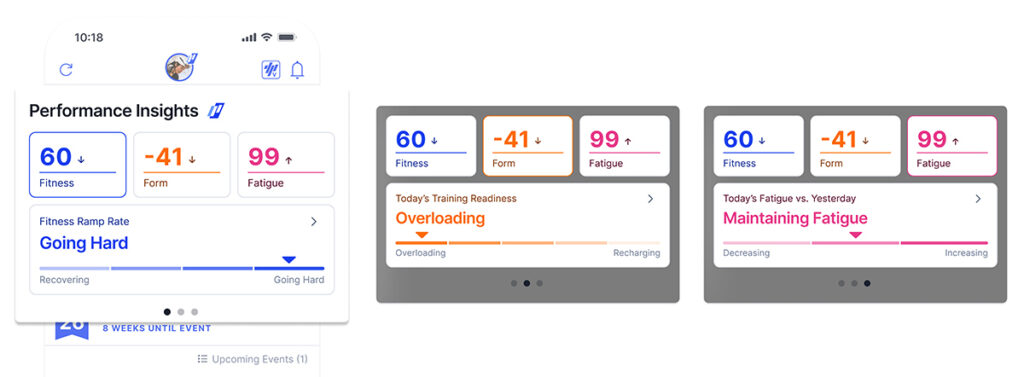
If you sync a device (like your Garmin, Polar watch, or other), TrainingPeaks can calculate your TSS, CTL, and ATL, metrics also known as your Fitness, Fatigue, and Form. These Performance Insights are available in your Athlete Home and tell you whether you’re gaining fitness, tapering, or overtraining. This makes it easy to see how your long-term and day-to-day training trends correlate, and if adjustments need to be made.
Measure your durability with Aerobic Decoupling and Efficiency Factor
Efficiency Factor (EF) shows how much output you’re getting for the physiological cost. It basically means: are you producing the same pace or power with less effort over time?
If your Efficiency Factor improves over time at a similar intensity, it means that you’re gaining fitness.
Aerobic Decoupling (Pw: HR and Pa:HR) indicates whether your heart rate and output remain aligned during a steady effort. If your pace or power stays the same but your heart rate keeps rising, that means you’re working harder to maintain that effort.
As a general rule, lower decoupling means better aerobic durability. If you can hold a steady long run or ride with minimal heart rate drift, it’s a good sign that your fitness is improving. If decoupling is high, that’s useful feedback, too: you may have gone too hard, you might need more base training, or you might be a little tired from the day (or days) before.
Use subjective feedback and recovery metrics to adapt
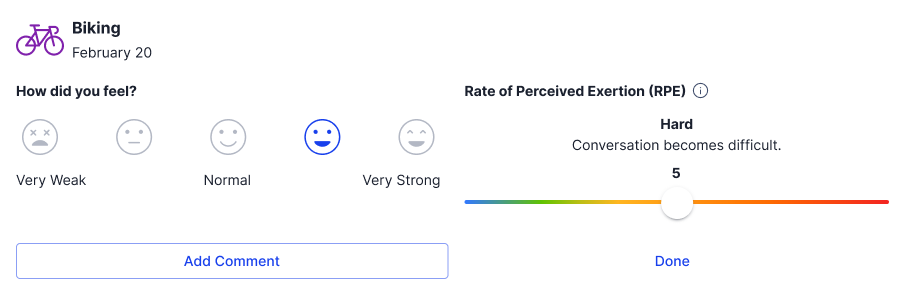
Don’t ignore the human side of the data. Use workout comments and RPE to track subjective data, and connect your Oura Ring, Garmin, Whoop or other to track recovery metrics in Athlete Home like sleep, heart rate variability, and resting heart rate.
Most importantly, don’t think of your training data in terms of “good” or “bad.” Think of it as information that helps you make decisions. If your power fades, your pace drops, or your heart rate drifts upward late in a workout, that isn’t a failure. It’s just information that tells you what to do next.
Training like a pro isn’t doesn’t mean forcing the plan no matter what. Pros don’t force. They make decisions based on information (training data).
Just ask Team XDS Astana.


