



The 113th Tour de France runs July 4–26 from Barcelona to Paris across 21 stages and 3,320 km (2,063 mi) and 54,450 m (178,640 ft) of total elevation gain. The Grand Tour will feature two races of truth: a 19.6-kilometer team time trial and one individual time trial of 26.1 km.
This is a climbers’ race, built around a punishing first week in the Pyrenean mountains, a deceptive middle stretch through the Vosges and Jura, and a brutal Alpine finale that includes back-to-back finishes on l’Alpe d’Huez. Six climbs make their Tour debut, and the Montmartre circuit returns for a second year in place of the traditional Champs-Élysées sprint.
At the center of it all is the rivalry between Tadej Pogačar, chasing a fifth title, and Jonas Vingegaard, arriving off a dominant Giro d’Italia with arguably the cleanest build-up of his career. Behind them, 21 debutants, including 19-year-old French prodigy Paul Seixas, UAE’s Isaac del Toro, and a deep field of GC contenders, sprinters, and breakaway specialists make this one of the most interesting start lists in years.
Two off-race developments shadow the Grand Départ. A severe European heat wave may force the ASO to shorten certain stages and even prompt the UCI to consider relaxed feeding rules for affected days. Separately, a coalition of human rights groups has called on the UCI to suspend UAE Team Emirates-XRG’s racing license over the team’s state ties, a controversy that puts Pogačar’s dominant squad under scrutiny before a single stage is ridden.
Below is a stage-by-stage guide with predictions, the key storylines to follow, and a full riders-to-watch breakdown.
Tour de France 2026: a Stage-by-Stage Guide
Stage 1 — Barcelona › Barcelona | 19.6 km (TTT) | July 4
A flat 15km at full gas, then the road pitches up for the 1.1 km Montjuïc castle climb before a final, steeper 800m punch to the line. New TTT rules mean riders finish on their own time rather than the fourth man’s, so team depth and rider selection matter from the opening kilometers.
Prediction: UAE Team Emirates-XRG take the stage; Pogačar gains a few seconds on most rivals before the race has truly begun.
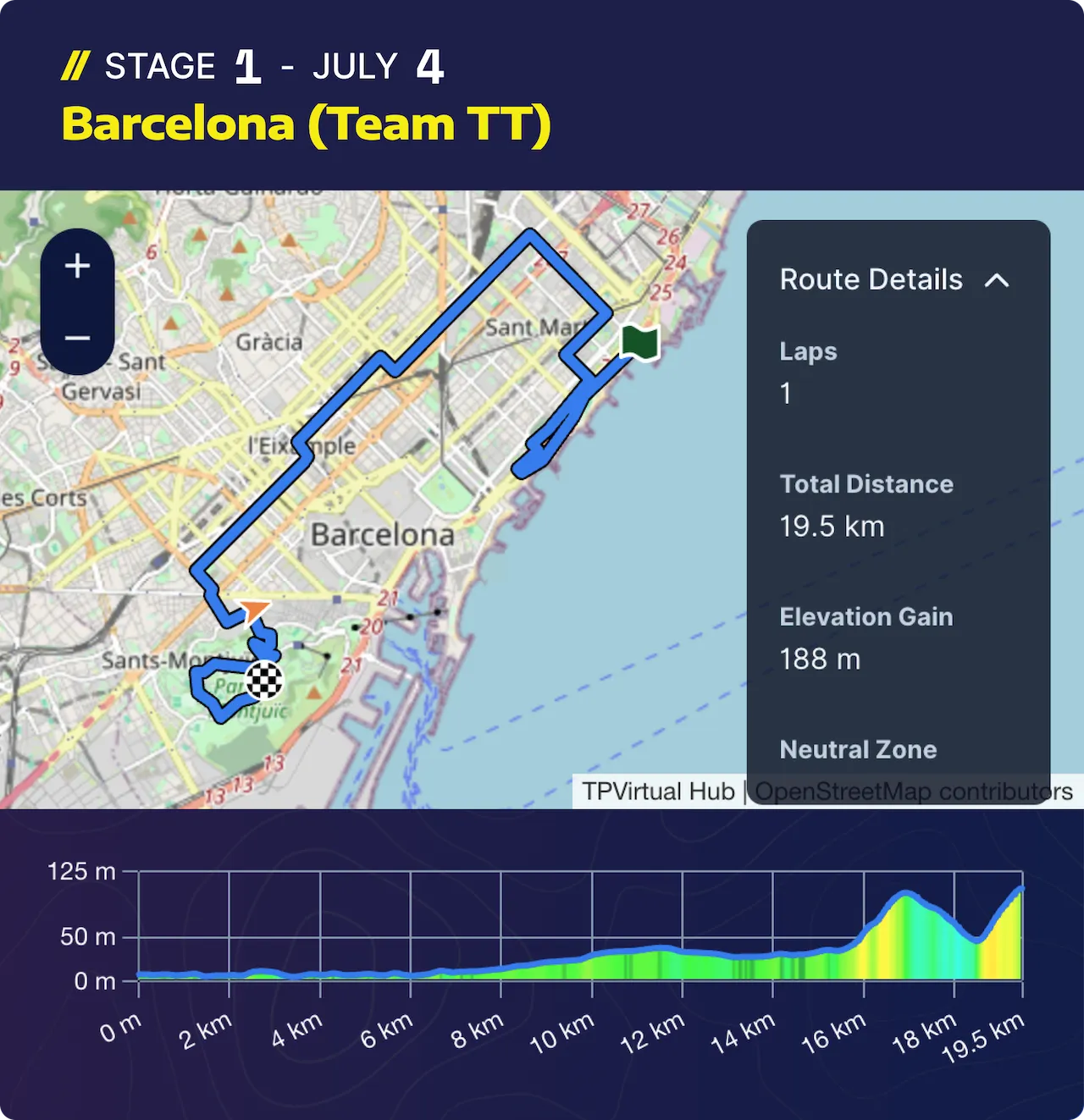
Don’t just watch it; ride it! TrainingPeaks Virtual’s Road to Paris allows you to ride each stage (you can ride the full stage or just the final kilometers). Powered by GPXplore, every climb, descent, and sprint finish is pulled straight from the actual terrain the pros are riding.
Stage 2 — Tarragona › Barcelona | 168.5 km | July 5
The same Montjuïc castle climb from Stage 1 returns, this time tackled three times (1.6 km at 9.3%), shredding any pretense of a sprint. The puncheurs are the obvious beneficiaries, but GC riders will be watching closely.
Prediction: A reduced bunch or lone attacker on the third ascent. Watch for Tom Pidcock or a puncheur-type to take yellow before the mountains arrive.
Stage 3 — Granollers › Les Angles | 195.5 km | July 6
The Tour crosses into France on its first true mountain stage. A Cat. 1 climb midway through softens legs before a 6.5% uphill finish, steep enough to drop sprinters, but gentle enough to invite a tactical race. This could be the first real GC sorting.
Prediction: Breakaway survives, or Pogačar’s team lights it up late. A first hint at Vingegaard’s condition.
Stage 4 — Carcassonne › Foix | 181.9 km | July 7
The Cat. 2 Col de Montségur crests 38 km from the line, giving attackers a window but also a long way to hold on. The more resilient sprinters may gamble on surviving the climb.
Prediction: Breakaway day. A domestique-turned-stage hunter takes the win; sprinters race their own internal battle for survival.
Stage 5 — Lannemezan › Pau | 158.3 km | July 8
Flat, fast, straightforward. A sharp left with 1 km to go and a technical run-in is the only complexity. First genuine sprint of the race.
Prediction: Jasper Philipsen or Tim Merlier, depending on who has the better lead-out arriving in Pau.
Stage 6 — Pau › Gavarnie-Gèdre | 186.2 km | July 9
The Tourmalet, hors-catégorie (“beyond category”) and merciless as ever, is the centrepiece. The finish itself rolls in at just 3.7% average, which dampens the potential for enormous time gaps, but the Tourmalet will have already done its damage.
Prediction: Pogačar or Vingegaard will test each other. A breakaway rider may claim the stage, but the Tourmalet will have rearranged the GC picture behind them.
Stage 7 — Hagetmau › Bordeaux | 175.1 km | July 10
A gentle rightward sweep along the Gironde estuary. Historically one of the Tour’s most prized sprint finishes after Paris. Expect full lead-out trains.
Prediction: Tim Merlier in a clean bunch gallop.
Stage 8 — Périgueux › Bergerac | 180.4 km | July 11
Back-to-back sprints, with two sharp right turns in the final 2 km adding positioning drama. A Saturday stage means big crowds and nervous racing.
Prediction: Philipsen or Olav Kooij, depending on who recovers better from Bordeaux.
Stage 9 — Malemort › Ussel | 185.5 km | July 12
The last stage before the first rest day. 3,300 m of cumulative climbing with no single monster climb, but the Mont Bessou at the end of a long false flat could decimate a break that’s run out of gas.
Prediction: A breakaway wins, but it will be a close call on the final climb. GC riders coast in together.
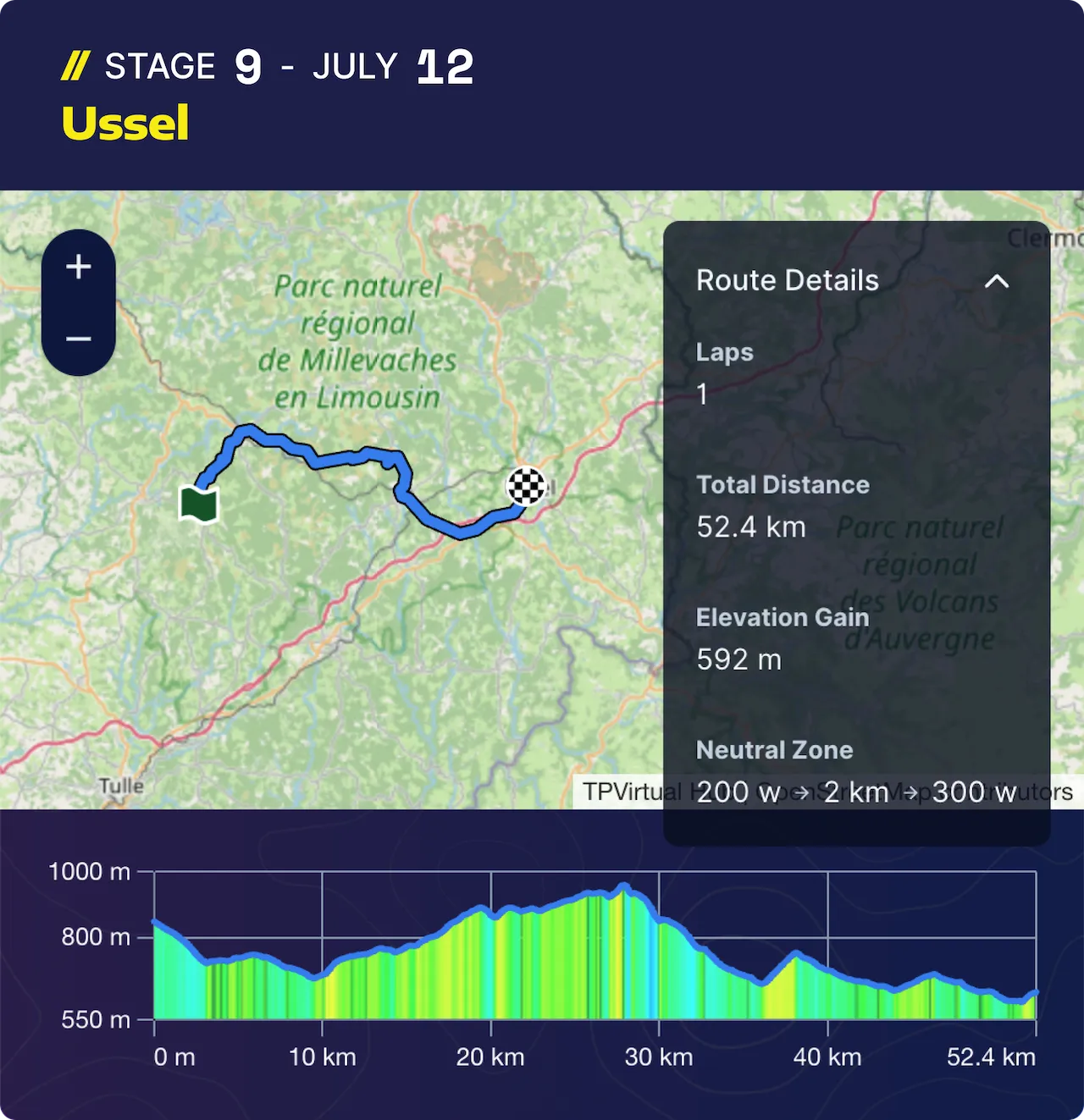
3,300 m of cumulative climbing! Do you have what it takes?
Stage 10 — Aurillac › Le Lioran | 166.6 km | July 14
Seven categorized climbs out of the rest day. This exact finish, the Pas de Peyrol, Col de Pertus and Col de Font de Cère, hosted a Pogačar-Vingegaard head-to-head in 2024, with Vingegaard winning by a bike throw. First real GC reckoning of the second week.
Prediction: Vingegaard attacks on the final climb. Pogačar responds. Everyone else loses time. This is where the race begins to take shape.
Stage 11 — Vichy › Nevers | 161.3 km | July 15
Flat with an S-bend finish. Pure sprint day tucked between two hard weeks. The sprinters still alive at this point will treat it like a stage win at any other race.
Prediction: Merlier or Philipsen, with Mads Pedersen a threat if the finale gets fractured.
Stage 12 — Nevers Magny-Cours › Chalon-sur-Saône | 179.1 km | July 16
Another sprint stage, this one through Burgundy’s Pinot Noir heartland. A late Cat. 4 offers token breakaway potential. The finale curves gently along the Saône, favouring riders with strong lead-outs.
Prediction: Philipsen, looking to build his points jersey lead.
Stage 13 — Dole › Belfort | 205.8 km | July 17
Deceptive. Mostly flat for 150 km, then the Cat. 1 Ballon d’Alsace arrives with enough gradient to shatter any sprint illusions. Could play like a mountain stage with a very long run-in.
Prediction: A small group of puncheurs or GC riders sprint it out after the Ballon d’Alsace. Juan Ayuso or Ben Healy is a possibility here.
Stage 14 — Mulhouse › Le Markstein Fellering | 155.3 km | July 18
Into the Vosges. The debut Col du Haag is the key: 11.2 km at 7.3% with double-digit pitches. The stage does not finish at the summit, leaving the door open for a reduced sprint if no one can get clear.
Prediction: A climber escapes over the Haag and stays away. Watch Tobias Halland Johannessen or Richard Carapaz here.
Stage 15 — Champagnole › Plateau de Solaison | 183.9 km | July 19
Del Toro used this climb to put a full minute into the field at the Auvergne-Rhône-Alpes in June. At 9% to the summit finish, it is the most likely stage of the first two weeks to produce serious GC time gaps. The race’s second rest day follows.
Prediction: UAE dictates. Pogačar or del Toro on the stage; Vingegaard limits losses or attacks first. This stage could effectively decide the race’s direction before the Alps.
Stage 16 — Évian-les-Bains › Thonon-les-Bains | 26.1 km (ITT) | July 21
The only individual time trial. An early Cat. 2 climb followed by a descent and flat run to the line creates a complex tactical puzzle with bike changes possible. Short enough to be shaped by the climb, long enough to move overall standings by a minute or more.
Prediction: Evenepoel wins the stage. But Pogačar is the best GC TT performer here, and the gaps between him and Vingegaard are the number that matters.
Stage 17 — Chambéry › Voiron | 174.7 km | July 22
Last flat stage before Paris. Sprinters who survived the Alps get one final shot, on a technical finish with three turns in the closing kilometer. With no Champs-Élysées bunch sprint this year, this is it for the pure speed merchants.
Prediction: Whoever among Merlier, Philipsen, and Kooij is still standing.
Stage 18 — Voiron › Orcières-Merlette | 185.2 km | July 23
Cat. 1 summit finish with a lot of uncategorized climbing before it. Teams may calculate their energy with two Alpine days left. A breakaway could succeed here if the big teams hold fire.
Prediction: A breakaway wins, unless one of the GC leaders senses an opportunity to gain time before the final two days.
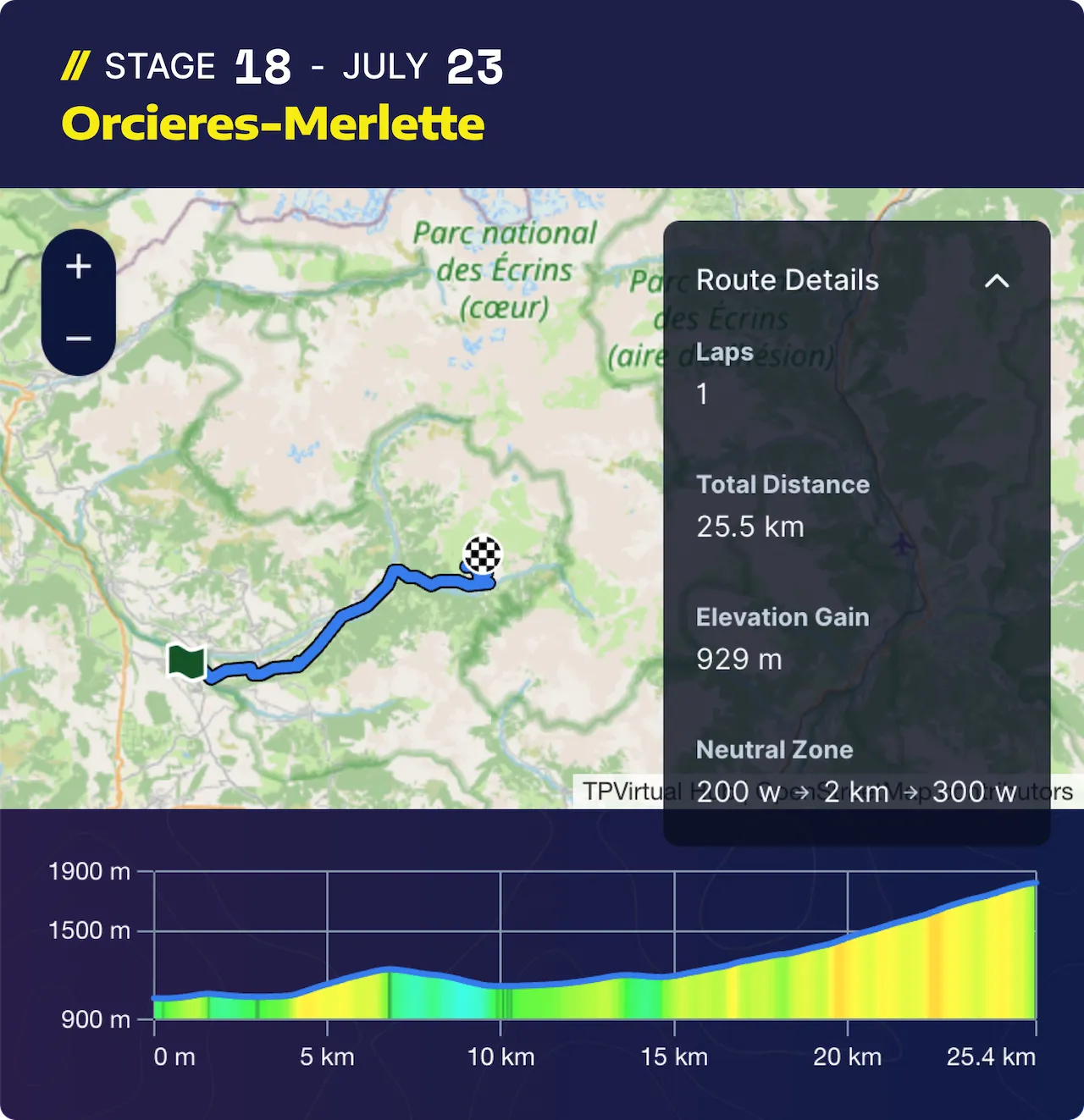
Cat. 1 summit finish with a lot of uncategorized climbing before it. Think you can do it?
Storylines to Follow and Riders to Watch
Can Vingegaard finally end Pogačar’s reign?
The central rivalry that has defined cycling since 2022 enters its most intriguing chapter. Tadej Pogačar (UAE Team Emirates-XRG) is chasing a fifth Tour title and a seat alongside Jacques Anquetil, Eddy Merckx, Bernard Hinault, and Miguel Induráin. He has been close to unbeatable in 2026, winning the Tour de Suisse by six and a half minutes and barely losing a race all year.
Jonas Vingegaard (Visma-Lease a Bike) arrives with perhaps the cleanest preparation of his career. Paris-Nice, Volta a Catalunya, then a dominant Giro d’Italia debut, where he won the maglia rosa with authority, including setting a Marco Pantani record atop Piancavallo.
Crucially, he has always maintained he performs better in the second Grand Tour of a season, having twice paired the Vuelta with the Tour. The Giro-Tour double is now the experiment. The question isn’t whether Vingegaard can compete. It’s whether he’s reached a level where he can sustain pressure across three weeks against the best stage racer alive.
Pogačar and Vingegaard are the race. Isaac del Toro (UAE Team Emirates-XRG) is effectively the third-best climber in this field. Paul Seixas (Decathlon CMA CGM) is a wildcard with genuine potential for top five. Juan Ayuso (Lidl-Trek), Tobias Halland Johannessen (UNO X-Mobility), and Remco Evenepoel (Red Bill -BORA – hansgrohe) are realistic top-six candidates.
The teenager who might matter most
Seixas will become the youngest Tour debutant in 89 years. At 19, the French prodigy has already won Itzulia Basque Country, La Flèche Wallonne on debut, and pushed Pogačar harder than anyone has this spring at Liège-Bastogne-Liège.
His pre-Tour preparation hit a wall at the Tour Auvergne-Rhône-Alpes, where a crash left him bloodied and eventually forced him to abandon, losing significant time to Del Toro before the exit. He recovered, and the team has confirmed he will start in Barcelona. What he learned about his own limits, at exactly the right moment, could define how this Tour goes for him.
Tour debutants
This Tour carries 21 debutants. Beyond Seixas and Del Toro, Cian Uijtdebroeks (Movistar) enters his first Tour quietly and with purpose, coming off solid climbing performances at the Auvergne-Rhône-Alpes. Johannessen finished sixth last year and may be underrated again. Ayuso, in his first Tour as outright leader, proved himself the second-best climber at the Auvergne-Rhône-Alpes, with Lidl-Trek also chasing green via Mads Pedersen.
Evenepoel and Florian Lipowitz (Red Bull-Bora-Hansgrohe) give the German team two podium finishers on paper, though whether either can break into the top three against this field remains the question their 2026 form has not yet answered.
Breakaways artists
The breakaway scene at this Tour is wide open. Several stages, particularly 4, 9, 13, and 18, are designed to let the race breathe, and the climber-heavy field means pure domestiques will sense opportunity. Ben Healy (EF Education-EasyPost) is the most likely to convert on a hard day; Tom Pidcock (Pinarello Q36.5) is the most dangerous on a day that mixes punchy climbs with chaos. Julian Alaphilippe (Tudor Pro Cycling), now in his third season with the Swiss team and riding his eighth Tour, arrives with one objective alongside Marc Hirschi: stage wins on punchy, nervous finishes, which this course offers in abundance. Keep an eye on Lenny Martinez (Bahrain-Victorious) on the harder days.
Don’t forget the sprinters!
The sprint windows are narrow but real: Stages 5, 7, 8, 11, 12, and 17 offer the pure sprinters their best shots. Tim Merlier (Soudal Quick-Step) leads the sprinters’ ranking entering the race, with Jasper Philipsen (Alpecin-Premier Tech) close behind. Philipsen ranks second in 28-day form among sprinters. Mads Pedersen (Lidl-Trek) doubles as Ayuso’s teammate but will hunt stage wins and the points jersey. Olav Kooij (Decathlon CMA CGM), a Tour debutant, is the youngest sprinter in the field and one to watch across the flat stages.
How to Watch the Tour de France 2026
- United States: Stream every stage live on Peacock, with select stages also airing on NBC and USA Network.
- Canada: FloBikes, live and on-demand.
- UK and Europe: Eurosport, available via Discovery+ or HBO Max.
- Australia: Free on SBS and SBS On Demand. France: France Télévisions, free and live.
The race runs July 4–26, with stages typically starting mid-morning local European time, which translates to early morning in the Americas.
Follow the Tour with TrainingPeaks!
More than 80% of WorldTour teams use TrainingPeaks to manage their performance data. This July, TrainingPeaks is going behind the results with We Speak Peak, a Tour de France hub spotlighting the coaches, performance teams, and data behind cycling’s biggest race.
Explore exclusive WorldTour coach Q&As, listen to former WorldTour Rider Alex Howes and Joe Lewis talk about each stage, and ride the Tour de France virtually with TrainingPeaks Virtual.
Tour de France FAQs
The 2026 Tour de France features 23 teams and 184 riders, with eight riders per team. The field includes all 18 UCI WorldTeams plus five UCI ProTeams, giving the race one more team than the traditional 22-team Tour lineup. Most of the WorldTour teams in the race use TrainingPeaks to manage, analyze, and track their riders’ training data across the season.
In the United States, the Tour de France will stream live on Peacock, with select stages also airing on NBC and USA Network. Canadian viewers can watch on FloBikes, while UK and European coverage is available through Eurosport, Discovery+, or HBO Max. In Australia, the race is available free on SBS and SBS On Demand, and in France, it airs on France Télévisions.
The 2026 Tour de France runs from July 4 to July 26. The race starts in Barcelona and covers 21 stages across three weeks, with riders racing nearly every day before the final stage.
The most important stages of the 2026 Tour de France depend on the race you’re watching. For the general classification, the decisive mountain stages will likely shape the battle between Tadej Pogačar, Jonas Vingegaard, and the other yellow jersey contenders. For breakaway riders, Stages 4, 9, 13, and 18 look especially important. For sprinters, Stages 5, 7, 8, 11, 12, and 17 may be their best chances to win.
The two biggest names are Tadej Pogačar and Jonas Vingegaard, whose rivalry has defined the Tour in recent years. Isaac del Toro, Paul Seixas, Juan Ayuso, Tobias Halland Johannessen, and Remco Evenepoel are also major riders to watch in the general classification battle.
That is the defining question of the race. Pogačar enters as the rider to beat, but Vingegaard arrives with a strong preparation and the confidence that he can perform deep into a second Grand Tour. If he can sustain pressure across three weeks, this could become the most interesting chapter of their rivalry yet.
Yes. Tadej Pogačar is expected to line up for UAE Team Emirates-XRG as the favorite for yellow and is chasing another Tour title.
More than 80% of WorldTour teams use TrainingPeaks to manage performance data. Through the We Speak Peak Tour Hub, fans can follow the race through coach Q&As, stage analysis, and virtual Tour de France rides on TrainingPeaks Virtual.


