



Sticking to your goal race pace in hot conditions isn’t mental toughness. It’s a physiological error with predictable consequences: a blown run split, a miserable final mile, or worse.
Heat changes the rules of pacing, and if you don’t change with them, the race will change you.
Why heat slows you down: the physiology
When your core temperature rises during exercise, your cardiovascular system faces a problem it cannot solve perfectly: your working muscles need blood to produce power, and your skin needs blood to dissipate heat. These are competing demands on a finite supply, and your body prioritizes survival over performance every time.
The result is cardiac drift (or Aerobic Decoupling): your heart rate climbs as your body routes more blood to the periphery for cooling. Your Zone 2 pace at 65°F now requires Zone 3 effort at 85°F. Your GPS watch doesn’t know this. It still shows the same pace, but your body is working significantly harder to hold it.
Humidity compounds this dramatically. Your body cools primarily through sweat evaporation, but evaporation requires the air to be drier than your skin. A 2025 study published in the Scandinavian Journal of Medicine & Science in Sports found that sweating efficiency drops from approximately 50% in low-humidity conditions to just 16% in very high humidity—a two-thirds reduction in your body’s primary cooling mechanism.
Hot and humid is categorically harder than hot and dry.
How much to slow down in the heat
A simple, practical tool is to add the air temperature (°F) and the dew point (°F), then use the result as your adjustment guide:
• Sum below 130: No adjustment necessary. Conditions are cool enough that heat is not a meaningful limiter.
• Sum 130-150: Slow down 2-3%. For a 9:00/mile target, run 9:11-9:17.
• Sum 150-165: Slow down 3-5%. For a 9:00/mile target, run 9:17-9:27. Conditions will meaningfully impact your cooling efficiency.
• Sum 165-180: Slow down 5-8%. For a 9:00/mile target, run 9:27-9:43. Conditions can lead to high heat stress. Reduce volume if training; adjust expectations if racing.
• Sum above 180: Slow down 8-10% or more. Conditions are dangerous. Exercise extreme caution, and prioritize finishing safely over any time goal.
Triathlon Training Tip → For triathlon run legs specifically, heat and humidity compound with the pre-existing fatigue from the swim and bike. Calculate your adjusted target pace before race morning so you know your number walking out of T2—don’t improvise when you’re already heat-stressed.
What to track on race day (and what to ignore)
In hot conditions, pace becomes a lagging indicator of effort. By the time your pace has slipped from target, thermal damage is already accumulating.
Here’s how to shift your monitoring hierarchy:
Rate of Perceived Effort first
Use Rate of Perceived Effort (RPE) as your primary pacing tool in the heat.
Training Tip → TrainingPeaks makes it easy to track your RPE over time. If you aren’t already, start recording your RPE after every training session and pay attention to trends. Using the Training Insights card in Athlete Home, you can see your 7-day average for Feeling and RPE, or click on the card for up to 90 days of workout history.
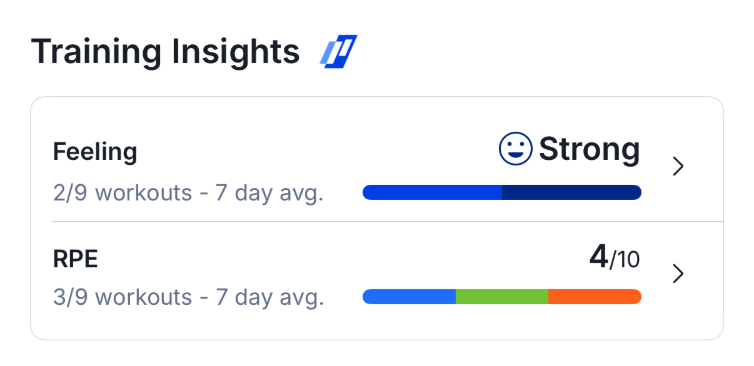
Practice monitoring and adjusting your RPE mid-run before race day.
Triathlon Training Tip → In a long-course triathlon in hot conditions, a sustainable RPE is typically 5 to 6 out of 10 for the first half of the run, with room to push to 7 if conditions allow in the final miles. If you’re at an 8 in the first 5km, you’re already in a hole you won’t be able to climb out of.
Heart rate as a secondary ceiling
Set a heart rate ceiling for the run—typically 10-15 bpm below your lactate threshold heart rate for moderate heat conditions and potentially lower in severe conditions.
If your heart rate hits that ceiling, slow down regardless of pace, RPE, or how good you feel. Getting ahead of cardiac drift is easier than digging out of it.
What to ignore
Your goal pace from cooler training conditions, your training partners’ paces, and your pace on this course last year in better conditions are all irrelevant on a hot race day.
Race the day in front of you, not a historical baseline built in different circumstances.
How to build heat acclimatization into your training plan
If your target race is hot, heat acclimatization should be built into your final training block. The adaptations are meaningful and within reach for age-group athletes training at home.
Research published in the Journal of Applied Physiology demonstrated that a 10-day heat acclimatization program increased VO2 max by 5% in cool conditions and 8% in hot conditions.
Plasma volume expansion begins within the first three to five days of heat exposure, followed by lower resting heart rate, earlier sweat onset, and improved sweat efficiency.
A separate 2025 Frontiers in Physiology study found that four weeks of heat acclimation produced a 21% increase in sweat rate alongside measurable improvements in ventilatory threshold.
You don’t need a heat chamber to see results. For most athletes, 10-14 consecutive days of training in warm-to-hot conditions (above 86°F) is sufficient to trigger meaningful adaptation. Even 30-40 minutes post-workout in a sauna or hot bath for 10-14 days can drive partial plasma volume expansion.
Training Tip → If you have access to an indoor trainer, consider using tools like TrainingPeaks Virtual and CORE for indoor heat training. Indoor training is a safe and effective way to build heat tolerance, and many runners use cycling to acclimate without adding mechanical stress to their legs. Afterward, use Analyze 360 to compare heat data with heart rate and power and track how your body adapts over time.
Common mistakes that will blow your run in the heat
Going out at goal pace regardless of conditions. The first 2-3 miles of a marathon or IRONMAN® run feel deceptively manageable. The heat deficit compounds in the back half. If you ignore conditions early, you’ll pay for it from miles 10 onward.
Underhydrating on the bike, then expecting to run well. Dehydration magnifies cardiac drift. Arriving at T2 even 2% dehydrated materially impairs thermoregulation and performance. Consistent fluid intake during the bike is the foundation of a functional run.
Chasing splits instead of reading your body. Your Garmin showing you’re 15 seconds behind target is not useful information if your RPE is already at 8. Your watch measures the external world. Your body measures the physiological reality. In the heat, trust your body.
Skipping cooling strategies at aid stations. Ice in your hat, cold sponges on your neck and wrists, and cold water over your head reduce skin temperature and core thermal load, allowing your cardiovascular system to direct more blood to working muscles and less to peripheral cooling.
Bottom line: what this means for you
Pace is not the goal; sustainable effort across the full run is the goal—and in the heat, those two things diverge significantly. If you know your adjusted target pace before race day, monitor your RPE and heart rate over GPS pace, use cooling strategies, and arrive at a hot race with 10-14 days of acclimatization behind you, you have already done more than most athletes at the start line.
The ones who run well in the heat don’t ignore the conditions. They plan for them.
Want a triathlon training plan that accounts for your race conditions, not just your fitness? NVDM Coaching’s triathlon programs are built around the athlete in front of us—conditions included.
References
Bright, F. M., et al. (2025, Mar 19). Elevated Humidity Impairs Evaporative Heat Loss and Self-Paced Exercise Performance in the Heat. Retrieved fromhttps://onlinelibrary.wiley.com/doi/full/10.1111/sms.70041
Lorenzo, S., et al. (2010, Aug 19). Heat acclimation improves exercise performance. Retrieved fromhttps://journals.physiology.org/doi/full/10.1152/japplphysiol.00495.2010
Xu, Y., et al. (2025, Jul 16). Four-week heat acclimation lowers carbohydrate oxidation of trained runners during submaximal exercise in the heat. Retrieved fromhttps://www.frontiersin.org/journals/physiology/articles/10.3389/fphys.2025.1581594/full


