



At rest, most people breathe roughly six to 10 litres of air per minute. During hard endurance exercise, you can exceed 100 litres per minute and might also shift toward mouth breathing, which bypasses some of the nose’s natural filtering. The result is that you may inhale far more pollution—and carry it deeper into your lungs—at a time when you’re asking the most of your body.
In most situations, the health benefits of regular physical activity outweigh the risks from air pollution, but it’s important to track your air quality to reduce your exposure to air pollution.
Your exposure is not fixed: a small change to when or where you train can reduce the dose you inhale without changing the purpose of the workout.
You can now treat air quality like any other training variable: check it, plan around it, and record what happened.
Sebastian Coe, two-time Olympic champion and President of World Athletics, put it simply: “It is high time that we are all equally demanding about the quality of air we breathe”.
How air quality impacts endurance athletes
During my PhD at Imperial College London, I measured traffic pollution in European cities. Air pollution can change from street to street and hour to hour. Your inhaled dose also depends on how long you spend somewhere and how hard you are breathing:
pollution concentration × breathing rate × time = inhaled dose
That is why Louise Thomas and I started Air Aware Labs and built AirTrack: we wanted to turn air quality data into practical decisions about where and when to exercise.
The main pollutants athletes encounter outside are fine particulate matter (PM2.5), nitrogen dioxide (NO2) from combustion and traffic, ground-level ozone (O3), and coarser particles (PM10) from dust and non-exhaust traffic emissions such as those from brakes and tyres. Wildfire smoke is primarily a particle problem, while ozone often builds on hot, sunny days.
Faster and deeper breathing during exercise increases the dose of whichever pollutants are present.
To illustrate why time and duration matter for athletes, we compared the estimated pollution doses received by Sabastian Sawe during his sub-two-hour 2026 London Marathon and by a recreational runner taking over six hours on the same course. We found that the two runners inhaled surprisingly similar doses. Despite running over four hours less, Sawe inhaled nearly the same amount of pollution because of rapid ventilation and the time of day.
Health effects of air pollution exposure on athletes
Short-term exposure can irritate the airways, aggravate asthma, reduce lung function, and make exercise feel harder. It has also been associated with changes in autonomic control, including lower heart rate variability (HRV). Long-term exposure increases the risk of cardiovascular and respiratory disease.
Some athletes notice symptoms such as coughing, wheezing, a sore throat, or unusual fatigue during the hours after a polluted session. Pollution can also hinder recovery by causing inflammation and autonomic strain.
Does air pollution make athletes slower?
It can. Air pollution affects health, and evidence shows that it can also degrade performance, though an Air Quality Index alone cannot predict an individual athlete’s time.
A US study of 334 male college runners linked exposure during the 21 days before a 5K with slower times. When comparing an average PM2.5 exposure of 10 micrograms per cubic meter (μg/m³) with 5μg/m³, the higher exposure was associated with a 12.8-second difference. A comparable contrast for ozone was associated with an 11.5-second difference.
Another study analysed more than 2.5 million finishers across nine major U.S. marathons. Each 1 μg/m³ increase in race day PM2.5 exposure was associated with an average 32-second slower finish for men and 25-second slower finish for women.
These studies show associations, but not a guaranteed time penalty—and results are often inconsistent. For example, a 2026 systematic review and meta-analysis of real-world sport studies found the clearest immediate performance signal for ozone, whereas evidence for short-term exposure to PM2.5, nitrogen dioxide, and overall AQI was less consistent.
What do air quality numbers mean?
An AQI converts pollutant concentrations into health advice, with higher values indicating worse air pollution. Indices differ between countries, so always check which scale is being used and which pollutant is driving the number. We recommend investigating the makeup of the different pollutants as opposed to a single AQI.
Furthermore, most weather apps and AQI services show a snapshot for an area or the nearest monitor. AirTrack uses machine learning modelling combining satellite observations, reference air quality monitors, low-cost sensors, traffic and weather conditions, terrain surfaces, and building heights. It then adds your route, time spent, activity level, and context to estimate personal exposure and inhaled dose.
The AirTrack Score (%) focuses on those choices rather than presenting another concentration. If you run beside a busy road when a cleaner park route is available, for example, your score reflects that avoidable exposure.
How to plan training around air quality
Three-time London Marathon winner and UN clean-air advocate Paula Radcliffe recently advised runners to check air-quality forecasts before heading out.
A simple way to do this is to use AirTrack alongside TrainingPeaks to plan and review workouts:
1. Check before you schedule
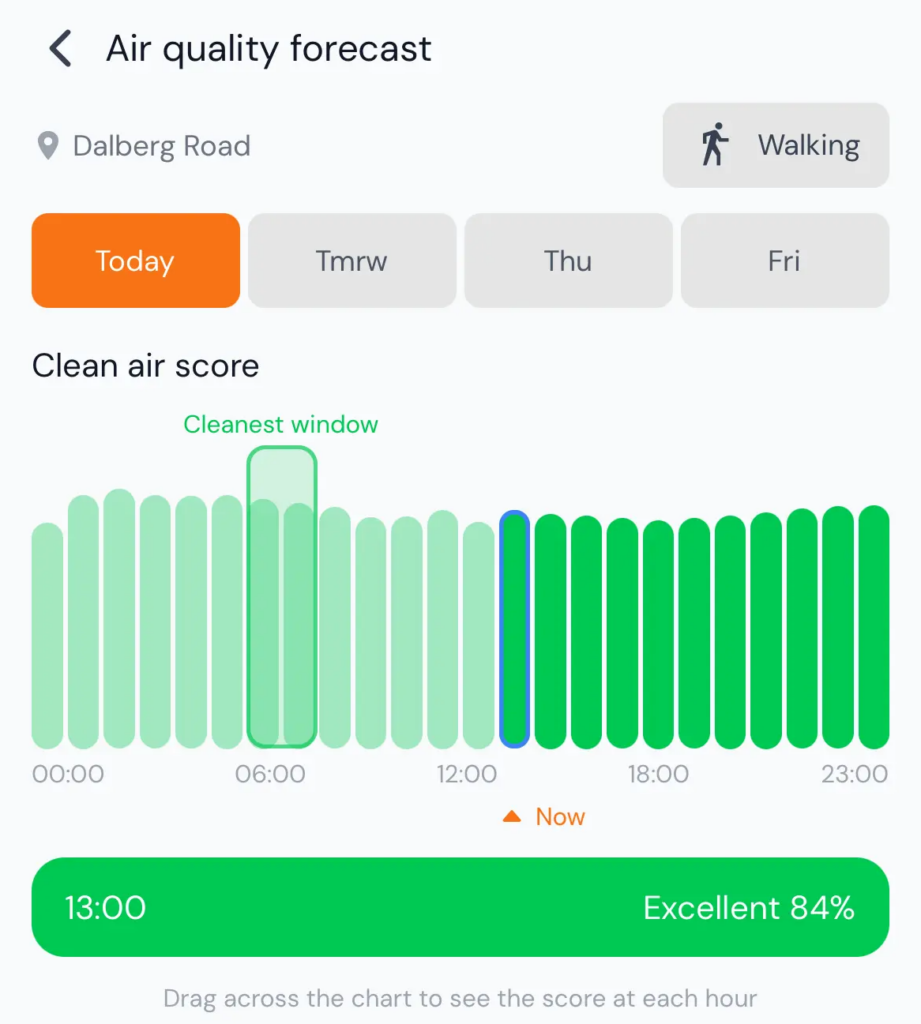
Use your AirTrack air quality forecast to identify a cleaner window and compare route options before you commit to a long or hard session.
2. Protect key workouts
Change the time, route, or location before changing what the session is meant to achieve. (Note: With TrainingPeaks Premium, you can easily swap workout dates.)
3. Think in doses
Intervals create high exposure due to rapid breathing rates, while a long Zone 2 session can produce a large dose due to duration. Prioritise cleaner air for both.
4. Adjust when necessary
If you cannot find a cleaner time or route, move the session to a clean indoor space or reduce its duration and intensity.
5. Record the outcome
Track concentrations and AirTrack Score, symptoms, heart rate, and rate of perceived exertion (RPE) in your TrainingPeaks workout summary and notes. Over time, this can help distinguish environmental strain from a change in fitness.
Is there an ideal time of day to train?
Early mornings are often best, but not always. Ozone rises on hot, sunny afternoons, while traffic related pollution can peak around commuting periods. Wildfire smoke can shift quickly with wind and fire behavior.
Check the local hourly forecast rather than assuming early morning is always cleanest.
When should you train indoors?
Indoor air is not automatically cleaner on an ordinary day, although a well-purified and ventilated gym can often be better. At home, cooking, cleaning products, mould spores, and candles can all generate different types of air pollution that are less relevant outside.
However, during periods of very high pollution, such as those during wildfire smoke, a well-managed indoor space would be the safer option. Close windows and doors, use effective air purifiers, and move your workouts indoors with a treadmill or indoor bike setup paired with TrainingPeaks Virtual so you don’t lose your training momentum.
Once outdoor air improves, ventilate your indoor space. See more practical advice in this guide to why indoor air pollution matters.
Take control of your exposure
You cannot control the air across a whole city, but you can influence how much pollution you inhale. AirTrack helps you understand your exposure and identify practical changes to when and where you exercise. If you regularly train outdoors, download AirTrack and see what difference a cleaner time or route could make.
Frequently Asked Questions
Often, but it depends on the pollutant, the AQI, the workout, and your health. Reduce exposure by changing the route or time first; shorten or ease the session when necessary; and move indoors when local guidance advises it. Stop and seek cleaner air if you develop chest pain, marked breathlessness, wheezing, dizziness, or unusual fatigue.
It can. Large observational studies have found slower average times on more polluted days or after more polluted training periods. Air pollution is only one factor and cannot predict your result on its own, but it is an environmental variable that many training and race-prediction models overlook.
I wouldn’t recommend it. Repeated ozone exposure may temporarily blunt some symptoms, but that does not mean you are protected from inflammation, impaired lung function, or other harm. Unlike heat acclimation, pollution exposure offers no useful performance adaptation to chase.
The same dose equation applies. Cyclists may spend longer outside and can sit directly in vehicle exhaust; runners may reach higher breathing rates near roadside sources. Route, intensity, duration, and pollution level matter more than the sport label.
A properly fitted N95, KN95 or FFP2 respirator can reduce exposure to particles, but the often quoted “95%” describes performance under test conditions, not a guaranteed reduction in the pollution you inhale. Fit and seal matter, while facial hair, sweat, and movement can create leaks. During hard exercise, when athletes have high breathing rates and are often breathing through the mouth, a respirator can feel restrictive, become hot and damp, and be difficult to keep securely fitted. These respirators also do not filter gases such as ozone or nitrogen dioxide. For most training, changing the time, route, or location is likely the more practical option.
References
Bernard, P. et al. (2026, July 13). Air pollution and performances in outdoor sports: a systematic review and meta-analysis of short-term associations in amateur and elite athletes. Retrieved from: https://journals.plos.org/climate/article?id=10.1371/journal.pclm.0000988
Cusick, M. et al. (2023, Feb 1). Impact of air pollution on running performance. Retrieved from: https://www.nature.com/articles/s41598-023-28802-x
Fleury, E.S. et al. (2024, Dec 18). Running on Fumes: An Analysis of Fine Particulate Matter’s Impact on Finish Times in Nine Major US Marathons, 2003-2019. Retrieved from: https://pubmed.ncbi.nlm.nih.gov/39690352/
Hung, A. et al. (2023, Oct 18). Personal strategies to mitigate the effects of air pollution exposure during sport and exercise: a narrative review and position statement by the Canadian Academy of Sport and Exercise Medicine and the Canadian Society for Exercise Physiology. Retrieved from: https://bjsm.bmj.com/content/57/4/193
US Environmental Protection Agency. (2023). Air Quality Guide for Particle Pollution and wildfire-smoke guidance. Retrieved from: https://www.airnow.gov/publications/air-quality-guide-for-particle-pollution/


