



Big workouts are kind of like small races. There’s not as much at stake as there is on race day, but they’re still important enough that you want to go into them ready to perform.
A lot has been written about what to do the day before a race. So, to prepare for your next big workout, you might assume you should follow the same guidelines.
…or maybe not.
While big workouts are slightly less demanding than races, they also serve a different purpose. The purpose of a race is to prove your fitness. The purpose of a big workout is to build it. It’s a subtle difference, but one that has important implications for what you do the day before.
Do a Moderately Challenging Workout the Day Before…
I learned an important lesson on this topic while collaborating with elite run coach Brad Hudson on the book Run Faster from the 5K to the Marathon. The training plans Brad created for the book included a number of big workouts that were preceded by a moderately challenging run the day before, rather than the expected easy run or rest day.
For example, a Friday interval workout might come after a Thursday progression run that culminates in a 3-mile acceleration from marathon pace to 5K pace.
Brad explained his use of moderate runs this way:
“For many years, the motto ‘go hard or go home’ has been an accurate representation of how most coaches approach training. Either you’re doing a very hard run to stimulate fitness adaptations, or you’re doing a very easy recovery run to help absorb the previous hard run and prepare for the next. But a weekly schedule that entails only two hard runs makes it possible to also do one or two moderate runs, in addition to easy recovery runs, without hampering your recovery from a previous hard run or sabotaging your performance in the next.”
That makes sense. But why place a moderate workout the day before a hard workout? Brad had two reasons.
Why Moderate Work Can Prime the Body
First, hard workouts are typically separated by about 72 hours, and it’s almost always best to train lightly the day after a hard session. That leaves the second day after a big workout (which is also the day before the next one) as the best remaining opportunity for moderate work.
Second, a moderate workout may actually help prime the body for harder work the next day.
You’ve probably noticed that your first interval is rarely your fastest in an interval set. This common experience is explained by post-activation potentiation, or the priming effect that a bit of harder work can have on the body’s capacity to perform. Brad noticed a similar phenomenon from one day to the next with his athletes, not just from one interval to the next.
When I started testing the method with my own athletes, I noticed the same thing. It was almost as if the moderate workout helped prepare the body for the following day’s hard effort. This idea is also supported by research on tapering protocols, which has consistently found that athletes tend to race better after a taper that includes some higher-intensity work than they do after one that is entirely low intensity.
And Brad Hudson isn’t the only successful endurance coach to use this approach.
Masato Niyoka, an elite running coach in Japan, often has his athletes perform what he calls pace runs the day before a big workout. These are essentially brisk easy runs, targeting an intensity just below steady-state, or the maximum intensity that can be sustained for about two hours. For example, Hitomi Niiya, who set a national record of 1:06:38 under Niyoka, did her pace runs at roughly 5:55 per mile. The equivalent pace for a 1:45:00 half-marathoner would be about 8:20 per mile.
…But Only if You Are at Least Moderately Fit
In my experience, doing a moderate workout the day before a big workout works well for moderately to highly fit athletes. It does not work as well for athletes at lower levels of fitness, who are often left too fatigued by the first session to perform optimally in the second.
As a rule of thumb, if you train seven hours per week or more, you’re probably fit enough that a moderate workout won’t leave you too fatigued to perform well the next day. If you train less than seven hours per week, you’re probably better off training lightly or resting the day before a big workout.
Workout Options
Here are three suggested formats for moderate workouts. Intensities are prescribed on a 1–10 scale of perceived effort, or RPE. Pace, power, and heart-rate versions of these workouts are also available in the 80/20 Endurance workout library.
Speed-Play Workout
10:00–20:00 @ 3–4 RPE
6–8 x 1:00 @ 7–8 RPE / 2:00 @ 2–3 RPE
10:00–20:00 @ 3–4 RPE
Fast-Finish Workout
30:00–50:00 @ 3–4 RPE
10:00 @ 6 RPE
Pace Workout
5:00–10:00 @ 3–4 RPE
20:00–50:00 @ 4–5 RPE
Training Tip → Create a free account with TrainingPeaks to upload your workouts directly to your device. You’ll also get a free 14-day trial of TrainingPeaks Premium, where you can use the drag-and-drop structured workout builder, analyze health metrics like HRV and heart rate, and see readiness insights based on your training history.
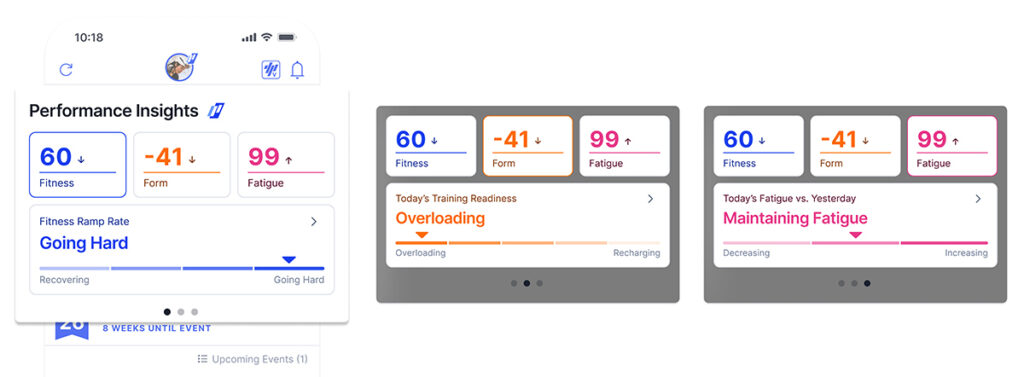
Performance Insights is a Premium feature that gives insights into your recovery and fitness. This can help you determine how hard to train the day before a hard workout. Try it for free for 14 days.
Remember, This Doesn’t Really Apply to Race Day
If moderate workouts are such an effective way to set up a big workout the next day, why not do one the day before a race?
There are two reasons: context and risk.
Big workouts happen in the context of normal training. Races, on the other hand, usually come at the end of a one- to three-week taper that is designed to minimize the risk of underperforming on race day.
An effective taper does include moderate workouts, but both scientific and real-world evidence suggest the last of these should happen two to three days before competition. That doesn’t mean you can’t have a great race the day after a moderate workout. But it’s probably an experiment best saved for a low-key event, not the Olympics.


