Lactate threshold training has become rather fashionable in recent years due to, in part, the success of several Norwegians across running and triathlon. Athletes, including Jakob Ingebritsen and Gustav Iden, have achieved success from intensity control using lactate measurements in training.
Lactate is a commonly misunderstood substance in the body. Conventional wisdom dictates that lactate is bad — something that ‘builds up’ when you go hard — so ‘fitter’ athletes produce less and, therefore, can go at some given intensity for longer. But this is an oversimplified interpretation of what’s happening. Lactate isn’t the waste product, as once believed.
In this article, we’ll break down what lactate testing actually tells you, how to avoid common protocol mistakes, and how coaches can use the results to set more accurate zones and identify an athlete’s key limiters.
What Is Lactate and Lactate Threshold Testing?
For athletes, lactate is a metabolic byproduct that plays a vital role in providing energy for exercise and can be measured to track performance. When the human body breaks down carbohydrates, lactate is produced. It’s an essential metabolite, a substance our body uses for fuel. It plays no part in fatigue as once thought.
Despite this, blood lactate does increase with exercise intensity, much like heart rate and RPE (rate of perceived exertion). Lactate threshold testing is a physiological assessment that identifies the intensity at which the body begins accumulating lactate in the blood faster than it can clear it. Lactate is measured in mmol/l (millimoles per liter of blood). The amount of lactate in our blood at various intensities can help us build a picture of the metabolic efficiency of an athlete.
Why Lactate Threshold Tests Matter for Athletes
Lactate testing is one of the most direct ways to spot where an athlete is limited. For example, you might see an athlete with strong top-end output but a relatively underdeveloped aerobic base—or the opposite. That insight makes it easier to set training zones with more precision, establish meaningful performance benchmarks, and track progress beyond “feel” or pace/power alone.
The bigger question is usually practicality. Whether an athlete should do a lactate test often comes down to resources: access to a reliable tester, time to run a proper protocol, budget, and a coach’s ability to interpret the data and apply it to training.
Another reality: there’s no single universally standardized field protocol. But there is a common pitfall you can avoid: stages that are too short.
Blood lactate doesn’t stabilize instantly after a change in workload. An athlete might read 1.5 mmol/L at 300W, then show the same 1.5 mmol/L two minutes later, not because lactate isn’t rising, but because the system hasn’t caught up yet. Hold that same intensity for five minutes (or longer), and the number may climb.
For cleaner, more usable data, plan stages of at least five minutes. The tradeoff is time: longer stages improve accuracy, but they also extend the overall test.

Testing Methods: Lab vs. Field
Both lab and field testing can be highly effective when the protocol is consistent and well executed. The real question is not which method is superior, but which one enables you to gather dependable data and translate it accurately into the athlete’s everyday training.
Testing Lactate in a Sports Lab
Access to a sports science lab depends heavily on where you live, and pricing varies by region. As a rough benchmark, a lab test often costs about half the price of buying your own blood lactate analyzer. If you decide to go the lab route, the main goal is simple: make the testing setup match the athlete’s real training environment so the results translate cleanly to day-to-day zones.
Before booking, confirm the lab can meet these standards:
- Stage length: Use steps of five minutes or longer so lactate values have time to stabilize.
- Bike setup (cyclists/triathletes): The athlete should be able to test on their own bike (ideally on a compatible trainer) or on a setup that replicates their position and fit.
- Runner-specific setup: If testing for running, ask whether the test is done on a treadmill and whether they can record pace and heart rate on the athlete’s own watch/HR strap, so the results translate to outdoor training.
- Device consistency: Record power and heart rate using the athlete’s own devices whenever possible.
That last point matters more than most people realize. Athletes train with their own power meter and heart rate monitor, and while different devices can read slightly differently, they tend to be internally consistent. If an athlete tests on a lab ergometer that reads 5% higher than their power meter, then builds zones off those lab numbers, the training prescription will be off from day one. That often shows up as workouts that feel harder than expected, chronic missed targets, and unnecessary fatigue.
The priority is consistent measurement. The closer the lab test mirrors the athlete’s real training setup, the more confidently you can apply those threshold results to training in the real world.e real world.
Buying a Lactate Analyzer
The other option is to invest in your own lactate analyzer. Most consumer models cost a few hundred dollars, and they’ve become increasingly common among professional athletes and serious amateurs because they make repeat testing and long-term tracking much easier.
If you test at home, the key is to follow a lab-style protocol. That means steady, incremental stages with consistent sampling and clear notes on pace or power and heart rate. On a smart trainer with ERG mode, this is straightforward since the workload is controlled for you. For running, the same principles apply, but it can help to have someone assist with sampling so the athlete can maintain pace and keep the stages clean.
How to do a DIY Lactate Threshold Test
A lab test run by an experienced practitioner is ideal, but it is not always practical. If you are using a lactate analyzer at home or in the field, the goal is to keep the protocol controlled and repeatable so the data is actually usable.
- Use a capable partner: Taking a sample is not hard, but doing it while the athlete is moving, sweaty, and breathing hard is. A partner makes sampling faster, cleaner, and more consistent.
- Control intensity: Precise workload control is the difference between a useful test and noisy data. For cycling, a smart trainer in ERG mode is the easiest setup. For running, a treadmill is usually the best option for consistent pacing and safe sampling.
- Start very easy, then build gradually: Begin at recovery effort (easy spin or easy jog). From there, increase workload in small steps. A common approach is +20–30 watts every 5–8 minutes for cycling, taking a lactate sample at the end of each stage. For running, use small pace increases on the same time structure.
- Record everything: Treat this like an experiment. Write down stage targets, actual power or pace, lactate values, heart rate, and anything that could affect readings (heat, fueling, sleep, recent training, soreness). Those notes are what make your next test more repeatable and your trends more meaningful.
- Pair lactate with the metrics you’ll actually train with: You will not be checking lactate in most sessions. The purpose of the test is to map lactate to practical anchors like heart rate, RPE, and power or pace, so you can prescribe training zones and interpret workouts without needing a blood sample.
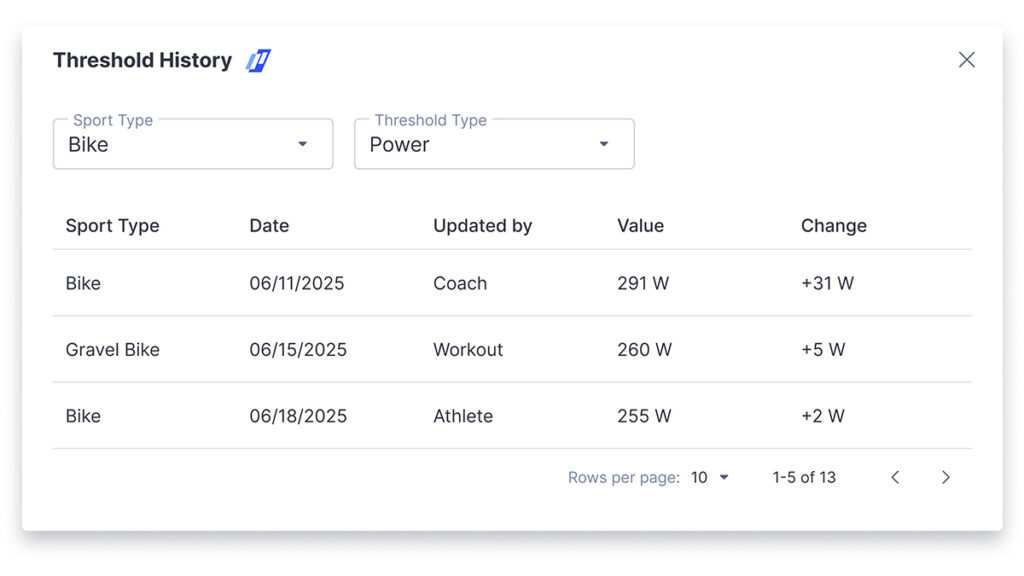
Coaching Tip → A single lactate test provides a snapshot of fitness, but the real value comes from seeing how thresholds evolve across training blocks. The Thresholds Over Time feature in TrainingPeaks allows coaches to track historical values and quickly determine whether training is driving the desired adaptations.
Interpreting Lactate Testing Results
Just like power data, lactate numbers only become useful once you understand the context. A single reading does not tell you much on its own. The value comes from how lactate changes as intensity increases, and what that trend tells you about metabolism and durability.
In healthy athletes, resting blood lactate is typically around 0–2 mmol/L. As intensity rises, lactate usually increases gradually at first. Then, at a certain point, it begins to climb much faster. Many protocols see that sharper rise occur somewhere around 4–4.5 mmol/L, but the exact number varies by athlete and test conditions.
Peak lactate can be very high, sometimes 20 mmol/L or more, and it is strongly influenced by the athlete’s profile. Athletes with more fast-twitch characteristics often produce higher peak values than aerobic-dominant athletes. A middle-distance runner, for example, is generally capable of higher peak lactate than a marathon runner. Peak values can also be lower when an athlete is carrying excessive fatigue or showing signs consistent with overreaching.
VLa Max, AeT, and AnT
When you look at lactate in multiple contexts, you can build a clear metabolic profile. Three concepts are especially useful when interpreting lactate data.
VLa Max (maximum lactate production rate)
VLa Max reflects how quickly the muscles can produce lactate through glycolysis. It is closely tied to high-intensity, anaerobic capacity. Whether “high” is good depends on the sport. Sprinters and short-duration athletes benefit from higher glycolytic power. Long-course triathletes and Ironman athletes often do better with a lower VLa Max, because higher lactate production can reduce the fraction of VO₂max they can sustain at LT2.
VLa Max can be developed with repeated longer sprints such as 30–60 seconds all-out with full recovery between efforts.
AeT (aerobic threshold, LT1)
AeT is the first intensity where lactate rises meaningfully above baseline. Below AeT, lactate remains close to resting levels and the effort is highly sustainable. At or just above AeT, lactate settles at a slightly elevated steady state.
As a simple example, an elite marathoner might finish an easy 30-minute jog with lactate near baseline. If they run closer to marathon pace for long enough, lactate is more likely to stabilize around their AeT. Improving AeT is broadly beneficial for endurance athletes because it raises the ceiling on “easy” aerobic work and increases sustainable output at lower cost.
AeT is most effectively improved through consistent, well-executed Zone 2 training.
AnT (anaerobic threshold, LT2)
AnT, also called LT2 or the lactate turn point, is the intensity where lactate begins to rise rapidly. On the curve, it is the point where the slope noticeably steepens. Practically, this often aligns with the highest intensity an athlete can sustain for roughly 30–60 minutes, depending on training status. In cycling, it often maps closely to FTP for many athletes.
Training LT2 is nuanced and debated, but a solid starting framework is work intervals around 95–105% of LT2 using a 2:1 work-to-rest ratio, adjusting based on how the athlete responds.
Profiling Athletes Based on Their Lactate Curve
The lactate curve is useful because it reveals strengths and weaknesses at a glance, and it changes predictably with training. During base training, coaches often aim to shift the curve to the right. That shift indicates the athlete can produce more power or run faster before lactate begins rising sharply, which is a hallmark of improved aerobic endurance. After a long break or detraining period, the curve often shifts left.

In this graph, the blue line represents the athlete soon after returning from a break, and the orange line represents the same athlete after a base phase. The orange curve shifts to the right, which indicates a stronger aerobic base. Lactate stays lower for longer as intensity increases, and the sharp rise happens at a higher workload, signaling improved aerobic fitness. Because the overall shape of the two curves is similar, it also suggests the athlete’s underlying metabolic profile hasn’t changed much.
Triathlon — All Sports are not Equal
Lactate numbers do not transfer cleanly from one discipline to another. Lactate is produced locally in working muscle and then appears in the bloodstream, so the amount you see at a given “effort” depends on which muscles are doing the work and how they’re being recruited.
That’s why testing conditions should mirror the sport you’re prescribing training for. A lactate profile collected on the bike can be useful for cycling zones, but it often tells you very little about what the same athlete will show while running. The muscle mass involved, recruitment patterns, posture, and mechanical load are different enough that lactate responses commonly shift.
For triathletes, best practice is to test and interpret lactate separately for the bike and the run, then set discipline-specific zones accordingly. In some cases, it can even make sense to test on different bike setups (road vs tri position) if the athlete’s goals and race demands differ.
Using Threshold Testing Results and the Power Curve in Training
Lactate testing tells you what’s happening physiologically at different intensities. A power curve tells you how that physiology shows up across real effort durations. Put them together and you get a clearer picture of what to train, and what not to chase.
Start by anchoring your endurance training around AeT (LT1) and AnT (LT2). Then sanity-check those breakpoints against the athlete’s power-duration profile. If an athlete can produce big numbers for a few minutes but falls apart when you ask them to sit near LT2, that usually points to an aerobic base or threshold durability issue, not a lack of “top end.” On the other hand, if LT2 looks solid but longer steady work fades, you may be looking at pacing, fueling, and fatigue resistance more than raw physiology.
The goal is not to collect more data for the sake of it. It’s to make sure the training intensity you prescribe actually matches the energy system you’re trying to target, and that the athlete can execute it consistently in the real world.
Key Takeaways for Coaches
- Lactate is not “bad” and not just a waste product. It is an important metabolic fuel and a meaningful marker of how the body produces and uses energy during exercise.
- Testing protocols matter. Not all lactate tests are created equal. Use stages long enough (ideally 5–8 minutes) so that blood lactate has time to stabilize before sampling.
- Match the test to the sport. Because lactate responses vary by muscle group and movement pattern, tests should replicate real training conditions (e.g., cycling tests for cycling zones, treadmill or controlled pace tests for running).
- Interpret lactate trends, not single numbers. The shape and shifts of an athlete’s lactate curve over time reveal changes in aerobic fitness and metabolic profile and help guide training and periodization.
References
Goodwin, M.L. et al. (2007, July). Blood Lactate Measurements and Analysis during Exercise: A Guide for Clinicians. Retrieved from https://www.ncbi.nlm.nih.gov/pmc/articles/PMC2769631/
Sanders, R. (2018, May 23). Rehabilitating lactate: from poison to cure. Retrieved from https://news.berkeley.edu/2018/05/23/rehabilitating-lactate-from-poison-to-cure/