



What if an Olympic medal was just the prologue? Molly Seidel became a household name in 2021 when she won bronze in the marathon at the Tokyo Games, just her third marathon ever. Since then, the Notre Dame standout and four-time NCAA champion has chased PRs on the roads, including a 2:23 in Chicago. But now she’s pointing her career in a new direction, one that comes with a bit more mud. Seidel is moving beyond the familiar rhythm of marathons to test herself on trails, setting her sights on ultramarathons as the next chapter of her career.
Seidel’s first true test will come in February at the Black Canyon 100K, a fast desert race outside Spring Valley, Arizona. Beyond that, she’s already eyeing the Javelina 100 in 2026, with her long-term sights fixed on the ultimate prize: a spot on the starting line of the Western States 100 in 2027.
While Seidel is a naturally competitive person, her move to the trails is about more than just results. The Olympic Bronze Medalist frames it as a reset.
“Trail running came back into my life in a big way in the last few years as I had to take a step back from the marathon due to injury,” said Seidel. “It first started as the only pain-free running I could do and then evolved into what was bringing me the most joy. I found a community around it. I also think there’s a lot of growth opportunities for me there, and right now the idea of improving my uphill running or technical downhill skills gets me more excited than shaving 30 seconds off a marathon time.”
The Wisconsin Native has always had one foot off the road. She grew up trail running and ran her PR in Chicago after a summer of running on dirt, which included racing the Speedgoat 28k, a steep and technical race located in Utah’s Wasatch mountains.
“The decision to focus more heavily on trails feels more like a realignment than a transition,” Seidel says. “I’ve been doing trails since the start of my career; I was always the kid that preferred cross country over track. It feels more creative as well, like it’s giving me the opportunity to expand my definition of what a successful running career could look like or who I am as an athlete.”
But First, The Big Apple
Before Seidel toes the starting line of her first 100k, she’s heading back to the New York City Marathon, where she finished 4th in 2021. She’s been working with Carmichael Training Systems (CTS) Coach Cliff Pittman to help guide her transitions to the trails, and Pittman has had two main focuses for her as she heads into NYC. First, to rebuild her aerobic capacity and raise her ceiling after time away from consistent training, and second, to re-establish her threshold power as the foundation for what’s next.
“Right now, she’s training very hard for NYC, but this isn’t her A goal; it’s a stepping stone,” Pittman explains. “The priority is to perform well while staying healthy and setting up a smooth transition into ultra-specific training afterward.”
While New York might not be the big focus at the moment, Seidel has still been hard at work laying the groundwork for the long races to come, tackling difficult threshold sessions and longer runs than she is used to.
“Marathon training is an absolute grind,” she explains. “It’s easy to romanticize past builds, but it is a knife fight when you’re in it. Remembering how to train hard, what it feels like to be pretty bone-tired from heavy threshold work, those are things I’ve missed the last two years away from the sport, but also still kinda dread. I think I’m really excited to race NYC, but also really ready to get into full ultra training after it and use it as a stepping stone.”
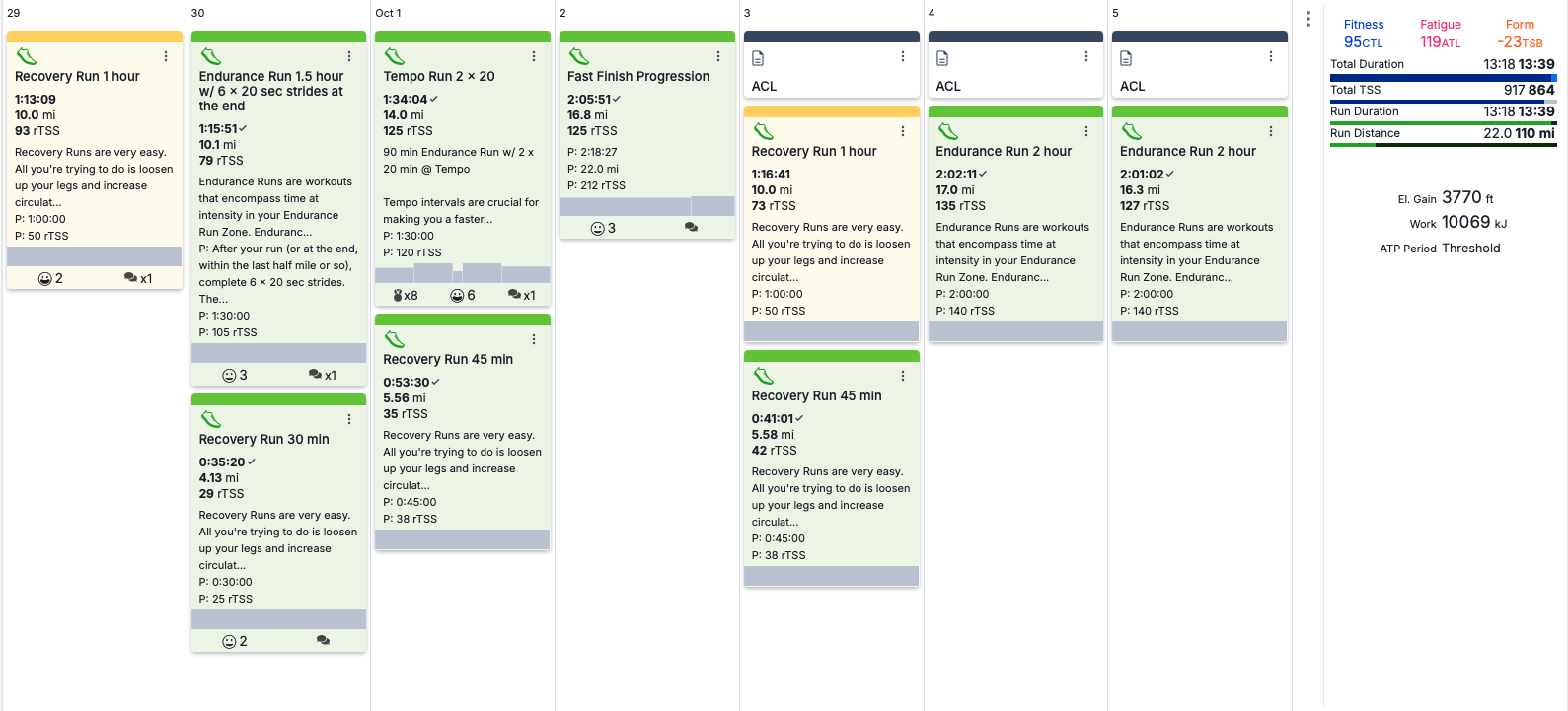
Seidel’s training looks different from her previous marathon builds, focusing on a more polarized, block-oriented approach, with bigger, specific workouts that are paired with more deliberate recovery.
Those hard sessions include workouts totaling up to an hour at lactate threshold (LT2), along with extended long runs that include time at specific intensities. The efforts are designed to give Seidel the metabolic and muscular endurance she’ll need as she transitions towards ultras.
Seidel started the marathon training build with a short block of work focused on training at VO₂max intensities to preserve central function and improve the muscle’s ability to extract and utilize oxygen.
“Much of Molly’s historical training emphasized threshold and marathon-specific work,” said Pittman. “So I suspected her lactate threshold sat at a very high percentage of her VO₂max.”
Having a threshold that sits right near VO₂max is great for marathon performance, but it leaves little headroom above threshold. Pittman gave Seidel short, intense sessions, like 5 x 5 minutes uphill at all-out effort to help raise the ceiling of her aerobic capacity and create more room for growth underneath.
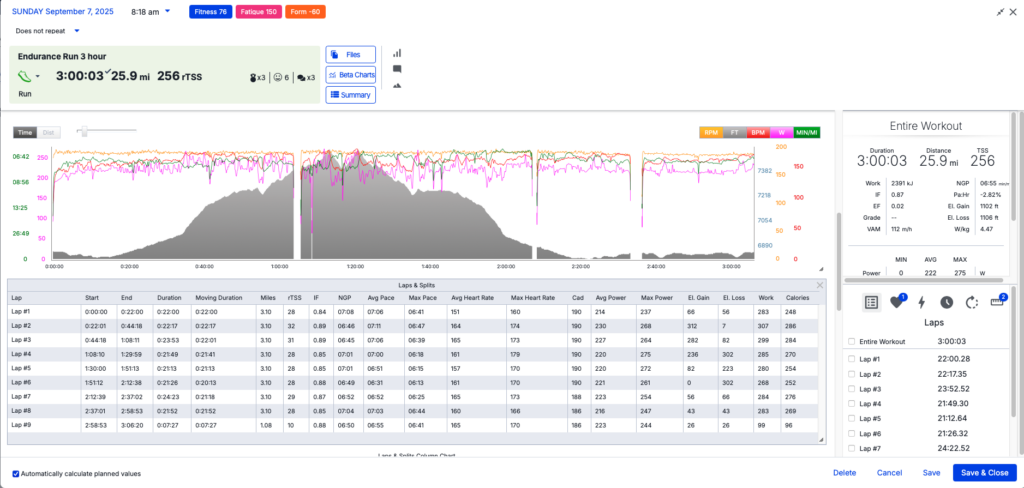
After that block, Pittman shifted her into an extended lactate-threshold phase, which was broken into two parts. Based on her training data, he estimated she needed about a 10 percent improvement at LT2 pace to realistically hit her NYC goal. That meant spending a significant amount of time right at that intensity, with two dedicated threshold sessions each week supported by 100-plus-mile training weeks. Early sessions hit 4 x 15 minutes at LT2, eventually adjusted down to 4 x 12 and 4 x 10 as cumulative fatigue built, maintaining quality without compromising recovery. Long runs also pushed into new territory, extending to 2.5 – 3 hours and occasionally covering marathon distances.
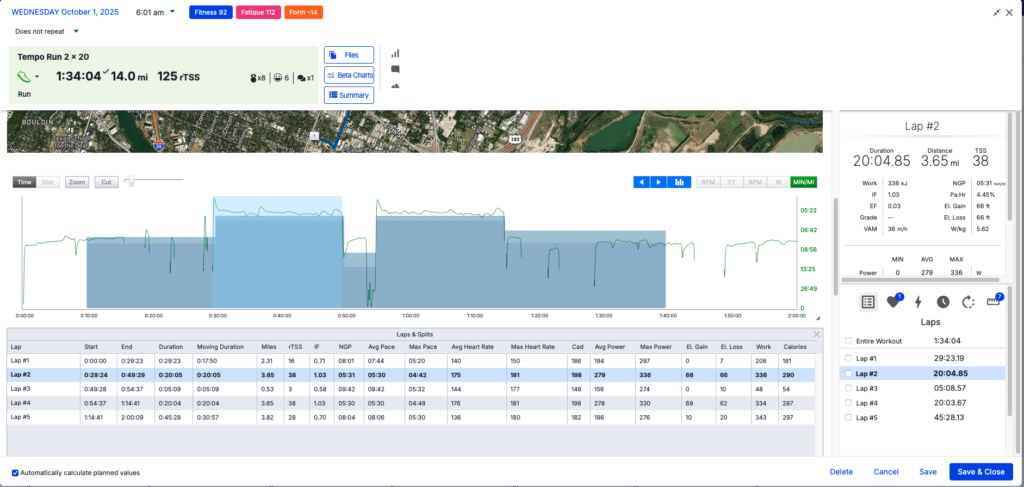
In September, Seidel ran a 1:17 half at altitude while battling GI issues. She wasn’t happy with it, but Pittman saw it as valuable feedback and was happy with how quickly she recovered.
Three days after the race, she completed a workout of 2 x 20 minutes at LT2 around 5:30 pace, which confirmed the adaptations they were targeting were taking hold. Her LT2 pace now sits below what had been her VO₂max pace earlier in the block, showing she has the capacity to be within reach of her goal for NYC.
Data that Guides the Process
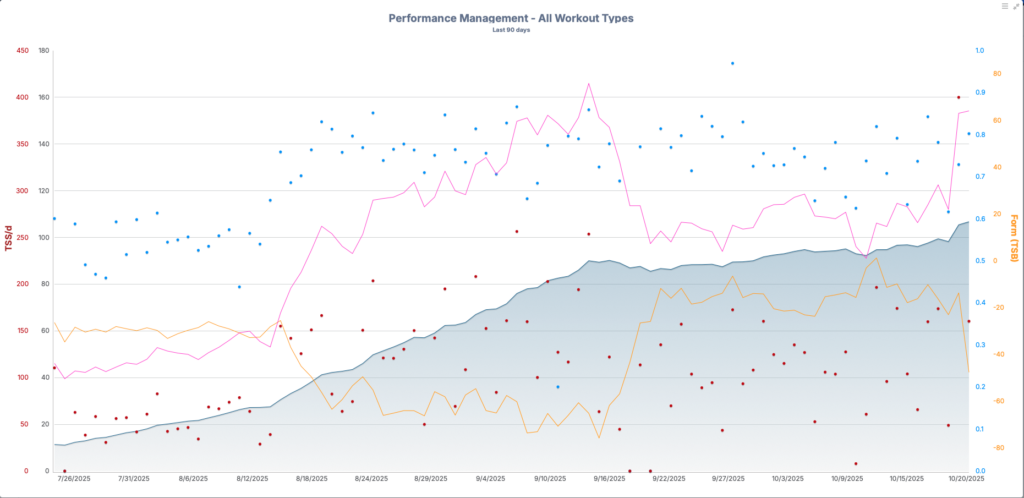
Pittman uses TrainingPeaks, the gold standard in endurance coaching software, to guide Seidel’s training. When Pittman breaks down Seidel’s workouts in the app, the first numbers he looks at are IF (Intensity Factor) and Pa:Hr (Aerobic Decoupling). IF is essentially a measure of how hard the session was compared to Seidel’s threshold. Pa:Hr, on the other hand, shows the separation between heart rate and pace during a session: if her pace drifts while her heart rate climbs, it signals fatigue. “A decoupling of less than five percent tells me she’s handling the load well and recovering between sessions,” Pittman explains. If IF comes in below target, that usually means she’s carrying too much fatigue to keep stacking stress, and it’s time to dial things back.”On the macro level, Pittman tracks her TrainingPeaks Performance Management Chart, which looks at three key metrics: CTL (chronic training load, a marker of long-term fitness), ATL (acute training load, a measure of short-term fatigue), and TSB (training stress balance, or freshness).
These numbers don’t prescribe workouts so much as confirm whether the training is producing the adaptations he expects. “I’m not chasing a specific number,” Pittman says. “I’m looking for trends that match the focus of the block. If the emphasis is threshold development, I want to see progressive load, but also recovery reflected in a stable Training Stress Balance pattern, not just an endless climb in fitness.”
Going Long
While many might assume that Seidel will be leaning on her speed going into longer trail races, she says that she’s most excited about the mental aspect of these events. Success in ultras often requires more than just talent; runners need to know how to keep pushing when they think that they have nothing left to give, and it is this part of the sport that Seidel seems ready to embrace.
“As a marathoner, I’m definitely not the fastest woman out there,” Seidel explains. “What set me apart in my best races was that when [expletive] hit the fan, I’m the one who knows how to deal with it.”
Seidel has typically had the most success at races that are held on challenging courses and in harsh conditions. The Olympic marathon in Tokyo was held in punishingly hot conditions, and the 2020 US Marathon Trials in Atlanta, where Seidel finished second, was on a very hilly course.For Pittman, the progression from a marathon to a 100K like Black Canyon follows what he believes is a logical shift, moving from emphasizing threshold and economy to focusing on steady-state endurance and fatigue resistance. This means progressing from threshold sessions to efforts at sub-threshold paces (Zone 3 in a 5-zone model), which enhance durability and substrate utilization. Seidel will also be tackling much longer long runs, moving from 2.5-3 hours on the road to 4-5 hour sessions on the trail. Pittman notes that some of these longer runs will be back-to-back, which enhances the stimulus.
To start the Black Canyon build, Seidel will be tackling longer steady state efforts like 2 x 30 minutes in zone 3 in the middle of a long run. As they get closer to the race, these efforts will move to the back end of long runs, which helps to teach the body to run fast later in a race, when glycogen is depleted and mental fatigue has set in.
Pittman notes that Seidel’s world-class aerobic capacity means that she doesn’t need to focus on Zone 3 work in the later parts of the build as much as other athletes, and can instead lean on high-volume training and back-to-back long runs to build resilience.
“The key point here is that Molly is not running slow for a 100K,” explains Pittman. “It’s that we’re optimizing her physiology to sustain submaximal output for 8 hours rather than two and a half hours.”
How Marathoners Can Transition to Ultras
Pittman says the biggest mistake road runners make is treating an ultra like a longer marathon. On trails, the demands shift from aerobic power to durability, energy management, and technical skill.
Nutrition and hydration also become paramount. Marathoners can often get away with mild dehydration and underfueling, but in an ultra, these mistakes can have catastrophic consequences. Additionally, the gear and terrain at these races can significantly alter biomechanics and muscular load. Becoming familiar with these aspects is critical for performance in longer events.
For Seidel, the priority is gradually weaving these elements into her training so that by the time she stands on the start line at Black Canyon, nothing feels unfamiliar.


