



The popularity of wearable technology is undeniable. Elite and recreational athletes alike use a variety of different devices to gather information about their training. This information includes metrics such as heart rate, sleep, or more running-specific variables such as pace and cadence.
The metrics delivered from such devices can also be incredibly useful to athletes and coaches. But unless you’re able to watch yourself run, you don’t get great insight into your running technique. Fortunately, the latest advancements in wearable technology can make it easier to track movement patterns to guide training.
Understanding Metrics and Biomechanics
It’s easy to get lost in all the different types of technology, what they can do, and why it matters. No matter how advanced the tech is sporting on their wrist or shoelaces, it means close to nothing if you’re not able to understand or view the information. The most important part of using wearable technology is understanding the metrics and why they matter. Use Analyze 360 in TrainingPeaks to see any metric recorded by your wearable.
Sensors like inertial measurement units (IMUs), accelerometers, strain gauges, and those measuring pressure can be incorporated into different systems like watches, insoles, power meters, and other wearable devices to give various biomechanical factors.
These sensors can be used to derive metrics that are typically grouped into the following categories:
- Spatio-temporal, which relates to time and space (e.g. stride length and cadence)
- Kinetic, which relates to forces causing motion or changes in motion (e.g. friction and gravity), and
- Kinematic, which relates to motion itself (e.g. velocity, acceleration, and rotation).
When it comes to running specifically and focusing on kinetics and kinematics, good metrics to know include ground reaction force (GRF), pronation, pelvic angles, and power. Loading rate and excessive pronation have been linked to plantar fasciitis, while excessive pronation can also contribute to medial tibial stress syndrome (also known as shin splints). Studies have also explored the relationship between pelvic angles and patellofemoral pain syndrome or medial tibial stress syndrome, but there is some conflicting evidence.
There are other metrics that you can measure in addition to GRF, pronation, pelvic angles, and power, but these have been studied more frequently when it comes to running economy and injury.
How Wearables Can Help Athletes and Coaches
Perhaps one of the biggest challenges for coaches and athletes is preventing/dealing with injury. Staying healthy is a challenge for runners at all levels, from beginners to world-class pros. Preventing injury allows you to maximize your training days and get to the start line prepared and ready to go. It also increases your longevity in the sport.
One of the big advantages of wearable technology is the ability for long-term monitoring outside of a lab. Your biomechanics often depend on your sex, the shoes you’re wearing, and your environment (like the surface you’re running on). Tracking this allows you to establish a pattern of how you move. This makes it easier to spot irregular movements that could lead to an injury. You can also use the data to inform any prevention training programs, such as mobility, strength, or plyometric work, that can reduce the risk of injury.
Understanding the context around different metrics can help you determine what is and isn’t normal for you. For example, in one study, when running at a self-selected speed and using an IMU placed on the sacrum to measure pelvic kinematics, no significant differences in pelvic tilt were observed between men and women, but women exhibited greater pelvic rotation. In another study, sensors were placed on the heel of running shoes to measure pronation while running on grass and track surfaces. There weren’t any significant differences in the amount of pronation on the two surfaces, but the higher maximum pronation velocity on the track was determined to be significant.
Wearable Running Tech Currently Available
Here is a list of some wearable technology that’s currently available and how to use it so you can make the most out of your training.
Insoles
These fit inside your running shoe, but athletes might need to remove the existing insoles in their shoes to have enough space for their feet.
- The NURVV Run insoles have 32 sensors that provide insights on power, pronation, and footstrike, among others. Athletes can interact with data on a mobile app, or through their Apple or Garmin watch, but would then need to share this information with their coach.
- The ReGo and OpenGo insoles by Moticon have 16 pressure sensors and an IMU in each insole. The ReGo insoles use a library of tests to provide insights including GRF and foot load, while the OpenGo insoles provide raw sensor data that can be used to derive metrics. Both have been designed for researchers, therapists, and coaches to use with their clients or athletes
Inertial Measurement Units (IMUs)
- RunScribe pods clip onto the top of a running shoe or into a hip mount. This dual functionality means you can get metrics from the foot (including pronation, power, and impact) and the pelvis (pelvic angles). The dashboard on the app allows coaches, clinicians, and researchers to analyze data for multiple people.
Power meters
- Stryd sensor clips onto the top of a running shoe (where the laces go). It’s compatible with different sports watches, and it syncs with TrainingPeaks. Users can get power data as well as other spatio-temporal metrics. The new Stryd Duo system gives left-right power and some additional balance-related metrics. Coaches may be interested in using Stryd Footpath to analyze data, but this requires a membership
Other systems have been used in research, including the Novel Pedar and Tekscan F-Scan GO System insoles, as well as IMUs from IMeasureU, DorsaVi, and APDM that may provide further biomechanical analysis.
Whatever wearables you use, you can create custom multi-channel charts in Analyze 360 to see how these metrics interact with others. So you can analyze how cadence or run dynamics change at difference paces or gradients.
Other Considerations
There’s a lot of technology out there, so you need to consider a few things before using it. For starters, there is some conflicting evidence regarding the links between biomechanical factors and running injuries. It’s important to look at what has been tested and validated by researchers. The field of wearable technology is constantly evolving, so the more you can stay up to date, the better.
Also, you need to consider how much the technology is going to cost and how comfortable it is to wear. Something that feels uncomfortable and affects how you normally move isn’t going to give you accurate data. How easy it is to interpret the data and communicate that with your athlete is an important factor to consider as well.
Finally, remember that the metrics from any wearable technology should be used alongside coaching and should never replace it.
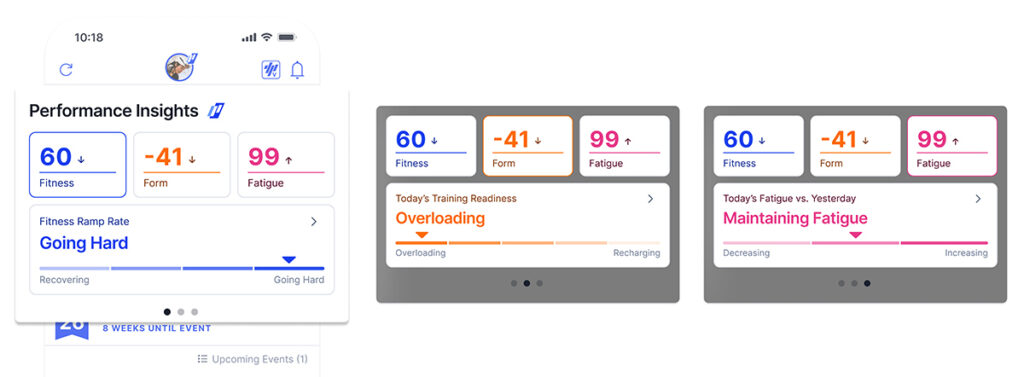
To help athletes stay injury-free, you should still prioritize the fundamentals: appropriate recovery, consistent communication, and careful monitoring of training load. Tools like TrainingPeaks Performance Insights can make it easier to view training trends over time, helping you and your coach spot when you may need more rest, a lighter week, or a small adjustment before a minor issue becomes a bigger setback.
References
IMeasureU. Sports Biomechanics – Movement Meets Tech. Retrieved from https://imeasureu.com/knowledge/sports-biomechanics
Lohman, E., Sackiriyas, K., & Swen, R. (2011, November). A comparison of the spatiotemporal parameters, kinematics, and biomechanics between shod, unshod, and minimally supported running as compared to walking. Retrieved from https://www.sciencedirect.com/science/article/abs/pii/S1466853X11001040
Moltó, I., et al. (2020, November 12). Wearable Sensors Detect Differences between the Sexes in Lower Limb Electromyographic Activity and Pelvis 3D Kinematics during Running. Retrieved from https://www.mdpi.com/1424-8220/20/22/6478
Willwacher, S., et al. (2022, March 5). Running-Related Biomechanical Risk Factors for Overuse Injuries in Distance Runners: A Systematic Review Considering Injury Specificity and the Potentials for Future Research. Retrieved from https://www.ncbi.nlm.nih.gov/pmc/articles/PMC9325808/


