



Most coaches already use training plans in some capacity, whether they realize it or not.
They build templates to save time with athletes. They reuse successful workouts and periodization structures. They create systems that help them coach more efficiently and consistently.
Selling training plans is simply the next step.
A well-designed training plan can do more than generate extra revenue. It can introduce athletes to your coaching philosophy, create a lower-barrier entry point into your business, reduce athlete churn, and help you scale your expertise beyond one-on-one coaching hours.
And as more athletes look for flexible, affordable ways to train, training plans fill an increasingly important gap between self-coaching and full-service coaching.
Training Plans Create Scalable Revenue
One-on-one coaching will always be valuable, but it is also limited by time.
There are only so many athletes a coach can effectively manage while still delivering a high-quality experience. Training plans allow coaches to scale their knowledge without scaling their schedule at the same rate.
Instead of building every program from scratch, coaches can package proven training systems into products that athletes can purchase at any time. Once the initial work is done, those plans can continue generating revenue with minimal additional effort.
This doesn’t mean training plans replace coaching. In many cases, they actually support it.
Athletes who purchase a plan become familiar with your methodology, communication style, and training structure before ever committing to personalized coaching. In that sense, training plans often function as both a product and a marketing channel.
A Lower-Commitment Entry Point for Athletes
For many athletes, hiring a coach is a meaningful step, but it can also feel like a big commitment. Between the cost, communication, accountability, and trust involved, some athletes may not be ready to jump straight into one-on-one coaching.
Training plans give coaches a way to meet those athletes earlier in the decision-making process.
Instead of asking prospective clients to choose between a generic plan and full-service coaching, you can offer a semi-custom plan as a middle option. This gives the athlete more structure and personalization without the ongoing commitment of coaching.
Chances are, you’ve already built something similar for a past athlete training for the same type of event or goal. After an initial conversation about the athlete’s goals, limiters, schedule, and experience level, you can adapt an existing plan into something more specific to their needs.
The result is a higher-value product for the athlete and a stronger lead-generation tool for your coaching business. They get a more personalized training experience, and you get the opportunity to introduce them to your coaching style, build trust, and create a natural path toward one-on-one coaching in the future.
Semi-Custom Plans Can Lead to More Athletes
One of the biggest advantages coaches have is that they rarely start from zero. If you’ve coached athletes for similar events, ability levels, or goals, you likely already have frameworks that can be adapted and customized quickly. That makes semi-custom plans especially valuable.
Instead of spending hours building a completely new program, coaches can modify existing templates based on an athlete’s goals, availability, strengths, and limiters. The athlete receives something far more personalized than a generic downloadable plan, while the coach delivers it far more efficiently than ongoing full-service coaching.
Over time, these athletes often become ideal candidates for one-on-one coaching because they already trust the process and understand your coaching philosophy.

An Alternative for Athletes Who Aren’t Paying for Coaching…for Now
Most coaches focus heavily on acquiring new athletes, but retention matters just as much.
Not every athlete leaves coaching because they are unhappy. Sometimes life circumstances simply change. An athlete may finish a major race, start a new job, have a child, face financial constraints, or temporarily shift away from competitive goals. That does not necessarily mean they want to disconnect from coaching entirely.
Training plans give coaches a way to keep those athletes within their ecosystem. So instead of losing the relationship altogether, coaches can offer lower-cost options that maintain continuity until the athlete is ready to return to more personalized coaching.
In many cases, these plans are easier to create because the coach already understands the athlete’s history, strengths, and progression.
The Most Successful Plans Are Usually More Specific
One of the biggest mistakes coaches make is trying to compete in oversaturated categories.
There are already thousands of generic marathon, triathlon, and cycling plans available online. Simply publishing another broad “Intermediate Marathon Plan” may not be enough to stand out. Specificity creates differentiation. Instead of targeting everyone, successful plans often focus on:
- Specific athlete types
- Unique race goals
- Niche events
- Time-constrained athletes
- Strength-focused builds
- Return-from-injury transitions
- Altitude preparation
- Masters athletes
- Beginner-to-intermediate progression
The more clearly a plan solves a specific problem, the easier it becomes for athletes to identify it as relevant to them. For an even more in-depth guide on how to add value to your training plans, check out this blog: How to Add More Value to Your Training Plans.
Partner With Events In Your Area
Another overlooked opportunity is partnering directly with races or event organizers.
While there’s no shortage of plans available for world-famous events like the Boston Marathon or Leadville 100, there are tons of other events out there, accompanied by promoters looking to increase participant value and assure athletes that they are well-prepared for the event.
Try researching high-participation events in your area and reach out to the promoter to see if they would be interested in offering an official training plan to participants. You might even find events that you’ve participated in or coached athletes for already. Promoters are often thrilled to offer participants this additional value without personally investing any extra work or cost.
If you provide the plan for free to all registered participants, then you increase brand awareness and possibly generate leads, but won’t earn extra revenue. If you offer the plan as at an additional charge to the registration fee, you may make some revenue but will also miss out on a lot of participants that skip upsells without much thought. Alternatively, try the best of both options by offering a free ‘Early Preparation Plan’ with training up to 8-weeks before the event, with a discount on the paid ‘Build-Taper Phase Plan’ to get them through to race day.
Make Your Training Plans Easier to Find
Once your training plan is built, the next step is getting it in front of the right athletes.
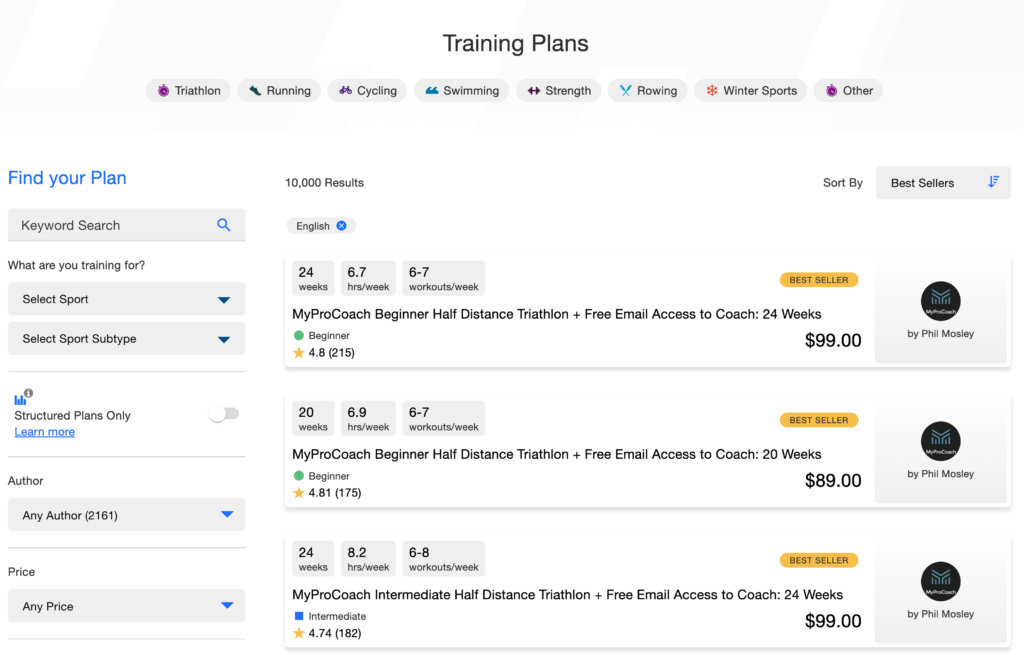
If you’re already using TrainingPeaks, publishing your plan in the TrainingPeaks Marketplace gives athletes a clear path to discover, purchase, and apply your plan to their calendar. But even if you’re not using TrainingPeaks yet, the Marketplace shows why building plans inside a platform can be valuable: athletes are already there searching for structure, guidance, and expert coaching support.
Instead of relying only on your website, social media, or word-of-mouth, a marketplace gives your training plans another place to be seen. That visibility matters, especially for athletes who may not be ready to hire a coach but are actively looking for a better way to train.
Your listing also becomes part of your coaching brand. The plan title, description, difficulty level, duration, and workout details all help athletes understand who the plan is for and why it fits their goal. A polished plan can introduce athletes to your coaching style and create a lower-commitment path into your business.
For coaches who want to reach more athletes, creating a TrainingPeaks account and publishing plans in the Marketplace can turn your expertise into a searchable, scalable product.
Selling training plans is a great way to earn additional revenue as well as generate interest in your coaching business. With a little bit of creative thinking and a more targeted approach, you can cut through the competition of generic training plans and get the most out of your time and effort.


