If you’re traveling for a race, chances are that the environment will impact your performance. For example, if you live in Minneapolis and travel to IRONMAN Cozumel without any heat prep, you’ll find yourself in for a surprise on race day.
Environment exerts a significant influence on performance, and understanding its effects is crucial for effective race preparation. Temperature, humidity, altitude, and wind each create distinct physiological challenges that can degrade performance if not properly taken into account.
Whether it is the heat stress of Kona, the thin air of a mountain climb, or a relentless headwind in a city marathon, the athlete who adapts to the race-day environment gains a critical edge and will likely outperform similarly fit competitors who are less prepared.
But the question is: Just how much of a difference will it actually make and how can an athlete best prepare for a new raceday environment?
This article looks at how temperature, humidity, wind, and altitude affect endurance performance, as well as how athletes can prepare for their next event.
Temperature: Understanding Heat’s Effect on Running and Cycling
The most common change in environment that athletes experience is a temperature change. And typically, but not always, it’s an increase.
Amongst triathletes, preparing for a hot race has historically and culturally been important within the sport, as the biggest triathlon of the year is in Kona in October. The average conditions in Kona are around 30 degrees Celsius with 80% humidity.
How Heat Affects Running
This study on runners showed that each degree rise beyond 10 °C (50°F) led to a 0.1–0.6% decline in finish times, depending on the athlete. Another study showed similar results, with performance declining 0.2–1.1% per degree beyond 17°C (63°F).
How Heat Affects Cycling
Similar performance decline in the heat is seen among cyclists, too, though it’s slightly less pronounced.
This study looked at nine cyclists completing time trials at 17, 22, 27, and 32 °C (90°C). Mean power dropped significantly at 32 °C (309 W) versus cooler trials (322–329 W). The mean core temperature of the riders also rose sharply above 30 km in the hottest conditions.
This meta-analysis showed an average of a 15% reduction in performance in the heat, but caution needs to be taken with this study as it is an amalgamation of studies and what “heat” means in each study is different.
What Research Shows Overall
Broadly speaking, it’s clear that heat impedes running and cycling performance. Evidence suggests that there may be a temperature beyond which heat typically starts to compromise performance more.
It’s also possible to infer that this temperature is lower for running than cycling, likely due to the larger oxygen consumption (and thus, higher metabolic cost) of running, as well as the lack of wind cooling.
It’s also clear from these studies that there are quite large individual differences in the impact of heat on performance. As such, it’s vital that coaches recognise whether their athletes are statistical outliers and either are particularly good in the heat or uniquely bad.
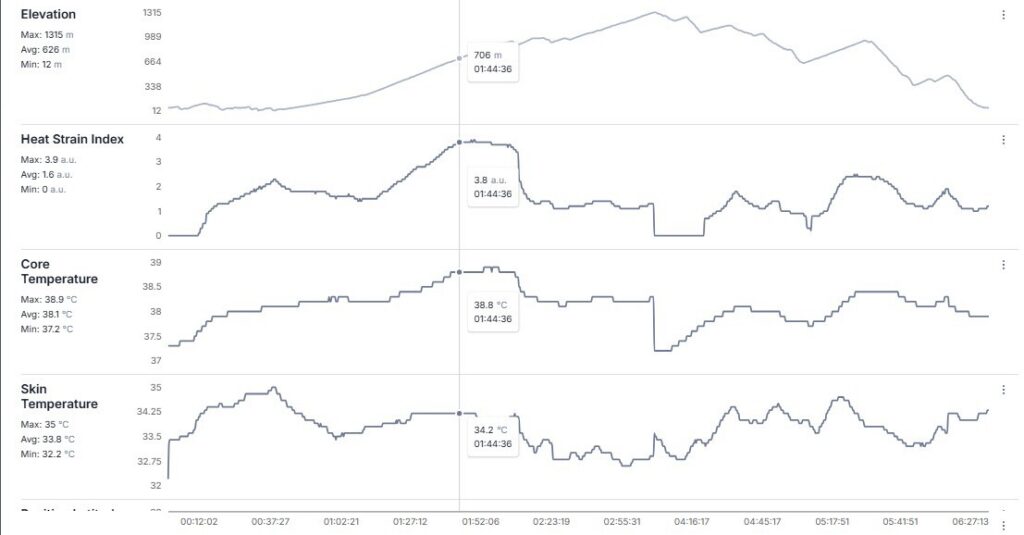
Coaching Tip → Using Analyze 360 in TrainingPeaks can help you see how heat strain affected a race or a workout. Learn more about how to do it here: Analyze 360: See and Analyze Every Metric in Training.
Humidity: Why It Feels Worse Than Heat Alone
Humidity makes it feel hotter than the actual air temperature because it interferes with your body’s natural cooling mechanism, preventing sweat from evaporating from your skin.
This perceived increase in temperature is what’s captured by things like the heat index or “real feel” temperature. The IRONMAN World Championships in Kona are a prime example of this, with the heat index giving a “feels like” temperature that’s much higher than what the thermometer reads.
This study on trained male distance runners doing steady state runs (70% VO₂max – typically around the first lactate threshold for many athletes) at 31 °C (88°F) with 23%, 43%, 52%, 61%, and 71% relative humidity found that in hot conditions, rising humidity reduces an athlete’s capacity to sustain performance.
Preparing for humid events and hot events are fairly similar. The trick is to train to what the race will feel like. The problem is not the heat, it’s the athlete’s body’s response to the heat.
This is a subtle difference, but the primary issue with humidity is that it prevents us from cooling down. When an athlete exercises, the human body heats up because muscles convert metabolic energy into mechanical work and much of that energy is released as heat during cellular respiration. Humidity compromises the athlete’s body’s cooling mechanism, meaning that heat can become overwhelming. Heat preparation improves the body’s ability to cool itself.

Altitude: Impact of Elevation on Power and Pace
Similar to heat and humidity, altitude reduces performance, but through different mechanisms.
Altitude manifests itself in two ways, either the entire event is at altitude or, like in many cycling races, there are climbs that start from relatively reasonable altitudes that subsequently go very high.
Altitude impacts endurance performance because lower oxygen levels at higher elevations reduce the amount of oxygen available to muscles. This study showed that mean maximal power (MMP) across durations (5–600s) fell by around 6% per 1000 m gain in elevation. At altitudes higher than 3000m, decreases exceeded 11.7%. Numerous studies and articles show similar drops in power.
You have two options when it comes to altitude: either acclimate for the specific altitude (not higher, as is shown in this study) or adjust your pacing according to the drop in performance you’ll likely see at that given altitude.
This blog gives examples of altitude adjustments you can give your athletes to help them prepare for events.
Wind: Resistance and Energy Cost
Everyone knows how much wind can impact cycling, but not as much is known about it’s metabolic impact on running.
Running into a headwind has been shown to decrease metabolic efficiency. During this study, runners (8M, 6F) ran on a treadmill at roughly 70 % VOC₂max with headwinds/tailwinds of 0, 2, 4, and 6 m/s. Core temperature was controlled to isolate aerodynamic effects. At speeds higher than 14 km/h (or 4:17/km), wind meaningfully raised energy cost.
Tools like myWindsock can show runners the impact that the wind and their environment has on them while running and cycling. During a race, the trick is to hide behind other athletes and draft (where legal). This will save you significant amounts of energy, even when running.
Unfortunately, it does not seem possible to become a wind-adapted athlete while running unless you have a uniquely aerodynamic body shape.
Tips for Acclimating for Race-Day Conditions
Adapting for a specific environment, whether it’s heat or altitude, should be considered a separate optimisation problem from training at altitude or doing a heat block to improve performance, though there are significant crossover effects between the two.
When to Start Acclimating
Preparing for a hot or high-altitude event requires targeted acclimation. Ideally, athletes should begin 2–3 weeks before race day.
Even 7–10 days can provide partial benefits, but a longer acclimation window allows for more complete physiological adaptation.
How to Acclimate to Altitude
Altitude acclimation typically requires more time than heat acclimation. Full acclimatization generally takes 3–4 weeks at the event altitude, and specificity matters. To prepare effectively, athletes should train at or near the altitude where they will race.
Shorter exposures may still provide some benefit, but they are unlikely to produce the same level of adaptation as spending several weeks at the target altitude.
How to Acclimate to Heat
For heat, daily exposures of 60–90 minutes can help increase thermal tolerance, plasma volume, and sweat efficiency.
These exposures can come from active sessions, such as training in the heat, or passive methods, such as sauna or hot water immersion after exercise. Many athletes and coaches are also now utilising indoor training as part of the heat training regimen. Heat acclimation may also improve performance in both hot and temperate conditions, partly due to increased blood plasma volume and other physiological adaptations.
Coaching Tip → Want to know how the pros use heat training? Pro coach Ben Day talks about the science of heat training and how the pros do it in this podcast: Can You Transform Your Fitness in Just 14 Days?
Monitor Signs of Adaptation
During an acclimation block, look for signs that the athlete is tolerating the environment more efficiently over time. Stabilizing resting heart rate, HRV, perceived exertion, heart rate response, and pace or power output can all help indicate whether the athlete is adapting or accumulating too much stress.
The goal is not just to complete heat or altitude exposure, but to understand how the athlete is responding to it. If key markers remain disrupted, the acclimation load may need to be adjusted before race day.
Coaching Tip → Again, using Analyze 360 can help. This is because you can look beyond pace, power, and heart rate by layering advanced physiological data, including heat strain, core temperature, skin temperature, breathing, and sweat metrics, onto the rest of the training file. This makes it easier to see how environment, intensity, and physiology interact.
Whether adapting to heat or altitude, the same principle applies: specific, consistent exposure is essential to prepare the body for the demands of the race.
Preparation should go beyond training intensity and duration specificity. It should include environmental specificity, with tools and strategies tailored to the conditions expected. This way, athletes can better control outcomes and maximise performance when it matters most and be as prepared as possible for the specific demands of their event.